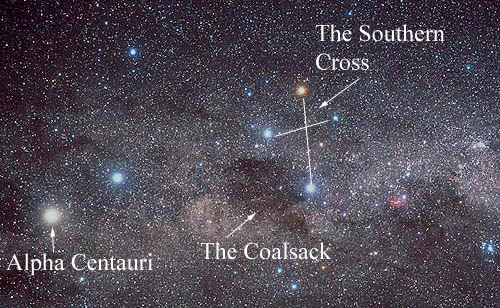
If you ask someone what the nearest star is, other than the sun, the likely reply will be Alpha Centauri. As it turns out, Alpha Centauri is actually a system of three stars discovered in 1915. The two main stars are a pair of binary stars Alpha Centauri A and Alpha Centauri B. They are termed binary stars because they orbit a common center of gravity (space.com). The third star in the system is named Proxima Centauri. So why then do people say that Alpha Centauri is the closest star to our sun? As it turns out when you look up at the night sky you see this three star system as a single star.
What Do We Know about the Physical Structure of Alpha Centauri?
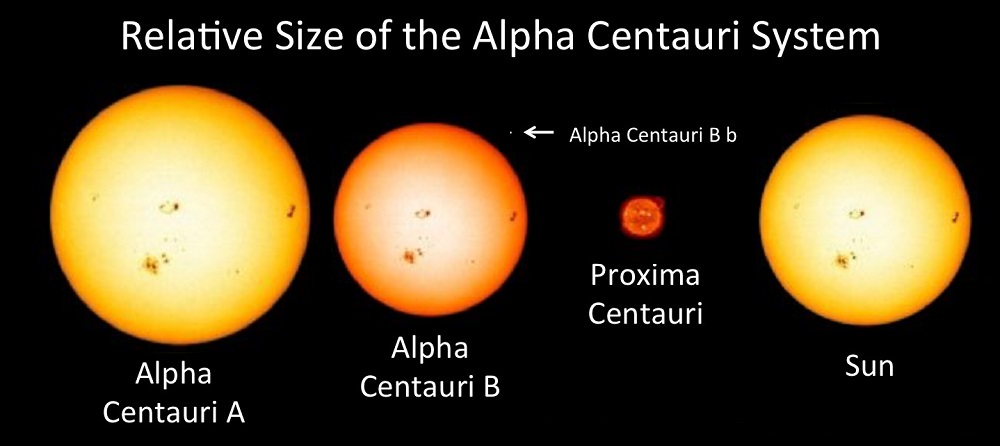
Let’s talk about the characteristics of each of the stars in this system. Centauri A has a surface temperature of 5770 K (10,000 F) which is similar to that or our own sun which has an average surface temperature of 5778 K according to evimage.org. According to earthsky.org Centauri A has a diameter 25 percent greater than our sun. The luminosity, or intrinsic brightness of Centauri A is 1.6 times the luminosity of our own sun
Centauri B has a surface temperature of 5300 K (9,000F) and a luminosity which is equal to one half the luminosity of the sun. Centauri is 90 percent the mass of the the sun. If Centauri B were not part of this binary system it would rank as the 21st brightest star in the night sky. (earthsky.org)
Proxima Centauri is a red drawf star which orbits the Centauri A&B pair. Proxima has a mass that is about 12 percent or ouf sun and a radius that is 14 percent the size of our sun (solarsystemquick.com) and is 20 thousand times fainter than our sun. (nineplanets.org)Proxima has a relatively cool surface temperature of 3500 K (5840 F).
Centauri A and Centauri B orbit a common center of mass with an orbital period of 80 years. The average distance between them is 23 AU or astronomical units which is the distance from the Earth to the sun. The distance between Centrauri A&B and Proxima Centauri is about 13,000 AU and it takes almost a half a billion years for Proxima to orbit Centauri A&B. (nineplanets.org)
How Far Away is Alpha Centauri?

We have stated that the three star system Alpha Centauri is the closest star to our sun but just how far away is it? Alpha Centauri A and Alpha Centauri B are an average distance of 4.3 light years from earth according to space.com and Proxima Centauri is 4.22 light years from earth. This may not sound like a large difference but it means that Proxima Centauri is 620 billion miles closer than Centauri A and Centauri B. (earthsky.org) Let’s take a moment to discuss the term light year. This is a measure of distance and not of time. A light year is the distance light can travel in a year. This distance is roughly 6 trillion miles or 9.5 trillion kilometers. In order for us to reach Proxima Centauri, the closest of the three stars, we would need to travel at the speed of light for 4.22 years. As a refresher, the speed of light is roughly 670,616,629 miles per hour, stated another nearly 671 million miles per hour. Even if we could somehow travel at that rate it would still take over four years to reach it.
Is Alpha Centauri a Planetary System?

You may be thinking about our star, the sun, and the planets that orbit it. We know this is our solar system and you may be asking yourself if the Alpha Centauri system has any planets orbiting it? The answer is yes, astronomers discovered a planet orbiting Proxima Centauri in 2016. The fact that this star has a planet orbiting it makes this a planetary system. A planetary system is simply a star with a planet or planets orbiting the star. You may ask how is that different than a solar system. The solar system is simply our planetary system which we named the solar system. The planetary system of this planet has three suns, Centauri A, Centauri B, and Proxima Centauri.
The planet orbiting Proxima Centauri is named Proxima b. The planet is 1.3 times as massive as Earth according to space.com and resides in the habitable or Goldilocks zone of the Proxima Centauri. The term habitable zone is a bit misleading as it does not necessarily mean that any planet in this zone can support life. What it does mean is that it is at an appropriate distance that if the planet has water it won’t freeze or boil off the surface. NASA defines the habitable zone as “is the range of distance with the right temperatures for water to remain liquid.”
Proxima Centauri b is is classified as a super Earth planet. Livescience.com defines a super Earth planet as “a planet with a mass between 1 and 10 times that of Earth. The super-Earth classification refers only to the mass of the planet, and does not imply anything about its surface conditions or habitability.” The exoplanet of the Alpha Centauri system has a radius that is 1.08 times the radius of the Earth. (exoplanets.nasa.gov) Proxima Centauri b has an orbital period of 11.2 days which means it takes 11.2 days to orbit Proxima Centauri and is only 4.7 million miles from Proxima Centauri which is about one half of an astronomical unit AU. By way of comparison the Earth is roughly 93 million miles from our own sun which is one AU.
Could Alpha Centauri Host Other Exoplanets?
In 2019 astronomers detected a second potential exoplanet orbiting Proxima Centauri. The object has tentatively been named Proxima c pending verification that the object is indeed a planet. This potential planet appears to reside in the habitable zone which sounds like an exciting prospect. According to space.com “the candidate world, which has a minimum mass about six times that of Earth, orbits 1.5 astronomical units (AU) from Proxima Centauri and is therefore probably very cold. Its equilibrium temperature hovers around minus 390 degrees Fahrenheit (minus 234 degrees Celsius).” Proxima c is 1.5 AU from Proxima Centauri which is a bit of a problem for astronomers. Scientists measure the gravitational effects of an orbiting planet or other object on the star. The effects are minor at on a smaller star at such a great distance.
How to View Alpha Centauri
As mentioned earlier Alpha Centauri appears to be a single star to the naked eye. This star system form the brightest star in the Southern constellation called Centaurus. Only the stars Sirius and Canopus appear brighter making Alpha Centauri the third brightest star in the night sky. Unfortunately for most of us in the northern hemisphere we are unable to see Alpha Centauri. Anyone north of 29 degrees latitude will not be able to view this bright star. Stargazers in portions of the southern hemisphere, including Australia, will note that the star is cirumpolar which means it never sets. If you are lucky enough to be in an area where you can view Alpha Centauri take advantage of it. Some of may never get to gaze directly at the third brightest star in the night sky. Here is a quick video tour of the Alpha Centauri system: Alpha Centauri Virtual Tour

 Neville’s Phantastic Physics Phun