Categories
astronomy cepheid variable physics solar system supernova

How Do We Measure Distances in Space: Cosmic Distance Ladder Part 2

cosmic distance ladder
Courtesy of http://www.as.utexas.edu

Last week we discussed several rungs on the cosmic distance ladder including stellar parallax, spectroscopic parallax, and main sequence fitting of stars. We discussed several astronomical terms associated with the cosmic distance such as astronomical unit, light year, and parsec. That discussion got us about halfway up the cosmic distance ladder. Lets ascend the rest of the way.

Variable stars

Courtesy of astronomytoday.com

Have you ever wondered if the brightness of stars ever change periodically? There is a class of stars called Cepheid Variable stars that do just that. According to the NASA website starchild.gsfc.nasa.gov/docs/StarChild/questions/cepheids.html, Cepheid Variables “are stars which brighten and dim periodically. In 1912 a Swiss scientists made a remarkable discovery regarding 25 Cepheid Variables located in the Magellanic cloud. Henrietta Swan Leavitt noticed that these stars seemed to brighten and dim at regular predictable intervals called periods. She postulated that the brighter the Cepheid, the longer the period. As it turns out once you know the period of one of these variables the brightness can be inferred.

Cepheid Variables fall into two general classes: the first are those of a period of pulsation from about 1.5 days to 50 days. These population 1 stars are often found in the spiral arm of galaxies. The second class of Cepheid Variables are Population 2 and are “much older stars less luminous, and less massive than their Population I counterparts.” These are stars “…with periods greater than about 10 days and BL Herculis stars with periods of a few days.” https://www.britannica.com/science/Cepheid-variable

So how do these stars which brighten and dim in predictable patterns help us determine the distance to nearby galaxies? The apparent magnitude of these variables can be plotted at different times to develop a light curve. A light curve is a relationship between brightness and time. Using the information from the light curve and data collected using sensitive photometric equipment, the apparent magnitudes and period of the star can be determined. These values can be plotted on a “period-luminosity” graph to determine its absolute magnitude. Once this value has been obtained you use the distance modulus formula to determine the distance to the Cepheid Variable.

Courtesy of astro.unl.edu

Standard Candles

Cepheid Variables and other astronomical objects, such as supernova, which have a known luminosity across the entire class of objects can be used to determine the distance of nearby galaxies as well as the expansion of the universe. These objects are collectively referred to as standard candles. According to http://planetfacts.org/standard-candle/ “A standard candle is a class of astronomical objects that belong to the same class and have a standard luminosity or brightness. You can actually determine an object’s distance from the earth using standard candles.” This method of distance measurement works like this according to planetfacts.org “…. a technical process which involves comparing the object’s brightness against a known or measured brightness from objects that belong to the same class. For example, you spot a certain object like a star or supernova, and determine that it is a standard candle; you can get its distance by measuring its brightness and comparing it to the known brightness of objects that are similar to it.” In our discussion regarding Cepheid Variables we learned about two different classes of these types of variables. If astronomers were trying to determine the distance of a far away galaxy, for example, and that galaxy had a Population 1 variable in it they could then compare its brightness to a Population 1 variable with a known distance to determine the distance of the galaxy.

Standard Candles
Courtesy of http://universe-review.ca/R02-07-candle.htm

The Tully-Fisher Relationship

We saw that by using variables and supernova as standard candles we could determine the distance astronomical objects. Is there a method to use the object which we want to study to determine how far away it is? Well, yes actually. The Tully-Fisher relation is just such a method. According to www.noao.edu/staff/shoko/tf.html the Tully Fisher relation is “a correlation for spiral galaxies between their luminosity and how fast they are rotating.” Scientists know that larger galaxies rotate with greater velocity then smaller galaxies.

Courtesy of spiff.rit.edu/classes/ladder/lectures/distant_gal/distant_gal.html#tf

“The key point of the Tully-Fisher relationship is that the speed of rotation of material in a spiral galaxy is related to the luminosity of that galaxy: high speeds occur in galaxies of high luminosity.” Again we see that by comparing the absolute magnitude against the apparent magnitude the distance of a given galaxy can be determined. The Tully-Fisher Relationship allows us to measure the distance of galaxies up to hundreds of megaparsecs away.

Courtesy of Pearson Education

Hubble’s Law

We have now reached the top ring of the cosmic distance ladder. Hubble’s Law can be used to determine distances to the edge of our universe. “What is Hubble’ law” is a question I hope you are asking. Glad you asked, Hubble’s law, according to http://hyperphysics.phy-astr.gsu.edu/hbase/Astro/hubble.html#c1“is a statement of a direct correlation between the distance to a galaxy and its recessional velocity as determined by the red shift. So what exactly is red shift?

You may have the heard the term “Doppler” when watching the weather on your local news. The term Doppler shift, with respect to light waves is an indication that the source emitting the waves is either moving toward or away from an observer. If the source is moving toward the observer the frequency of the waves increases as the waves bunch up toward each other. A result of this increased frequency is that the light is blue shifted, meaning the color is shifted toward the blue end of the spectrum. Bluish colors have higher frequencies than do reddish colors. If the source of light is moving away from an observer the light is shifted toward the red end of the spectrum as the frequencies are reduced. Here is a good explanation of Doppler shift both for sound and light waves: https://www.youtube.com/watch?v=h4OnBYrbCjY&feature=youtu.be

Courtesy of schoolphysics.co.uk

Fantastic, now we know about the Doppler shift but what does this have to do with Hubble’s law? In 1929 Edwin Hubble made a shocking discovery. He was able to determine that every other galaxy was flying away from us. Perhaps even more astonishing was the fact that the farther away a galaxy was the faster it was moving away from us. The law which bears his name states that the velocity (v) of a galaxy is equal to the product of the Hubble constant (H) * the distance to a distant galaxy. This relationship is generally used to find the distance of galaxies over a billion light years away.

Courtesy of space.fm

The velocity of the galaxy is a measure of the recession rate of the galaxy, in other words how fast the galaxy is flying away from us. The Hubble constant has an estimated value of 70 kilometers per second per megaparsec. Not only can this equation be used to determine how far away and how fast galaxies are moving from us but this equation was used to prove that the universe was in fact expanding. So how was Edwin Hubble able to determine that these galaxies were moving away from us, well he was able to determine a red shift of each of the galaxies he observed. Hubble’s law has also contributed to many of astronomy’s deepest and most fascinating issues including providing the “first concrete support for Einstein’s theory of Relativity… It also helps validate theories of Dark matter and Dark energy. A recent discovery in 1998 revealed that the expansion of the universe is accelerating.” this according to planetfacts.org/hubbles-law/

Well I hope these two posts hope clear up how astronomers determine the distance of objects from our own solar system out to the edge of our universe. As technology continues to evolve and develop I would expect that new and improved ways of measuring cosmological distances will soon be devised. Maybe someday technological advances will allow us to go and explore the universe up close and in person.
Categories
astronomy Betelgeuse cepheid variable physics solar system supernova

Supernovas and the Death of Red Supergiant Stars

The red supergiant, Betelgeuse has been in the news recently because of its unexpected behavior. Astronomers have noted that since October 2019 the red supergiant had been dimming and the star is now less than 40% of its normal brightness. Before we discuss what this means for the star let me introduce you to Betelgeuse.

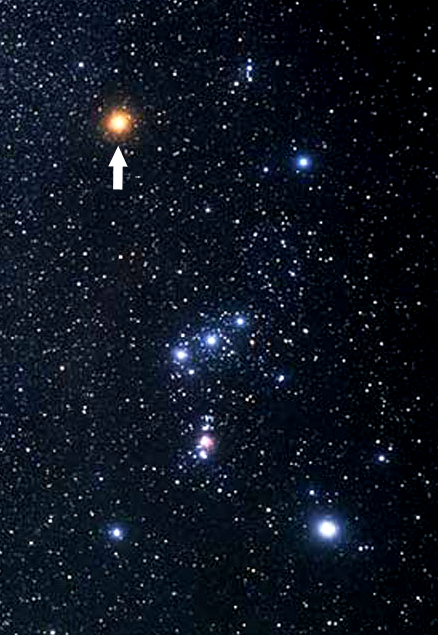
Betelgeuse is between 640-724 light years from Earth and is the alpha or brightest star in the constellation Orion. Betelgeuse and Bellatrix make up the shoulders of Orion, the Hunter. Betelgeuse used to hold the distinction of being one of the top 10 brightest stars in the sky but has fallen to below 20th since it began dimming in October 2019. Betelgeuse is believed to be between 9 and 10 billion years old with a solar mass that is 12 times more massive than our sun.

find betelgeuse,betelgeuse in orion constellation
Image: Akira Fujii

Red Supergiants

So what is a red supergiant star? Red supergiants are stars of a specific size that are nearing the end of their lives. These stars spend only about 10% of their lives as red supergiants while the prior 90% is spent as a massive main sequence star. These stars have a mass greater than 10 solar masses meaning these stars have more than ten times the mass of our sun. In these stars most of the hydrogen fuel has been exhausted and the core stops producing energy and gravity causes the core to contract. The layer of the star surrounding the core contracts and heats up to a high enough temperature to start fusing hydrogen to helium. The outer parts of the star expand as a result of the star burning hydrogen. The star is producing more energy than necessary to offset the collapse due to gravity. The outer layer expands to several hundred solar radii and the surface temperature cools as a result of the increased surface area. This temperature decrease gives the star its reddish color.

Courtesy of se.ssl.berkeley.edu

The Dimming of Betelgeuse

Betelgeuse belongs to a class of stars called Cepheid variables or variables. These types of stars, according to universetoday.com “are essentially stars that experience fluctuations in their brightness (aka. absolute luminosity)”. So this means that some dimming from Betelgeuse is to be expected. Betelgeuse is considered to be a semi-regular variable star or slow irregular variable star which means its brightness or luminosity fluctuates in fairly predictable cycles. One cycle lasts for approximately 420 days, a second longer cycle lasts for close to six years, and a third cycle lasts somewhere between 100 and 180 days. The current reduction in brightness is larger than expected which has led to questions about what this means for the red supergiant. Some scientists think that this dimming is simply an extended dimming period lasting longer than the 420 day cycle while others speculate that Betelgeuse may be heading towards its ultimate demise, a supernova explosion. The European Southern Observatory (ESO) posted a video comparing the luminosity of Betelegeuse from December 2019 to January 2020, you can view the video here: https://www.youtube.com/watch?reload=9&v=o1ls7Gr9LTE According to ESO “this video shows the star Betelgeuse before and after its unprecedented dimming. The observations, taken with the SPHERE instrument on ESO’s Very Large Telescope in January and December 2019, show how much the star has faded and how its apparent shape has changed.”

What is a Supernova and When Might it Occur for Betelgeuse?

According to nasa.gov, a supernova is “the explosion of a star. It is the largest explosion that takes place in space.” There is some speculation that Betelgeuse is nearing the end of its life and may go supernova in the near future. Let’s be clear about the meaning of “near future”. In our everyday life the “near future” may be a few days, a few weeks, maybe even a few months. Is astronomical terms, the “near future” may mean anywhere from a few thousand years to over a hundred thousand years. It is all based on your reference. Astronomers are comparing a few thousand years to the age of the universe which is estimated to be nearly 14 billion years old.

What Is A Supernova?
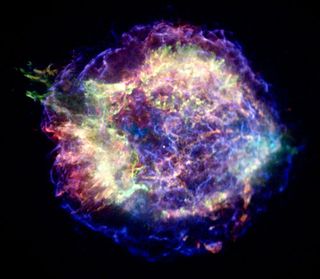
This Chandra X-ray photograph shows Cassiopeia A (Cas A, for short), the youngest supernova remnant in the Milky Way.
(Image: © NASA/CXC/MIT/UMass Amherst/M.D.Stage et al.)

When the iron core reaches its Chandrasekhar mass which is about 1.4 times the mass of our sun or 1.4 Solar masses, the pressure of the core can no longer hold up against gravity and the iron core begins to collapse. During this collapse the electrons and iron nuclei get mashed together and electrons combine with protons in the nuclei to form more neutrons. This combing of electrons and protons results in a decrease in pressure which speeds up the collapse. The collapse of the core takes a mere few thousandths of a second.

As the core of the star reaches a size of around 31 miles the core contains a gas consisting of 70% neutrons and 30% protons with a temperature of 100,000,000,000 K. This object is now a proto-neutron star. The outer layers are continuing to fall into the core and a stream of neutrinos are flowing out of the proto-neutron star. This flow of neutrinos results in an enormous release of energy causing the outer layers of the star to be blown away. This flow of neutrinos is responsible for 99% or this enormous energy and light is the remaining 1% of the energy.

The brightness or luminosity of a supernova is 10 billion times greater than that of our sun. A supernova may outshine its own galaxy for several days. So why aren’t we seeing supernovas all the time? Shouldn’t we be able to detect them by the enormous luminosity? Scientists have found that core collapse supernova only occur at a rate of 1 supernova per century per galaxy.

Types of Supernova

There are several different types of supernova. They are classified by the type of light that is emitted by star. This can be thought of as the chemical signature of the star. These signatures help astronomers determine what elements are present in or created by the star.

The first is called type 1a supernova. Scientists believe that this type of supernova occurs when white dwarf stars, those stars who had masses less than 1.5 times the mass of our sun, acquire more mass than its internal pressure can withstand so it heats up and goes supernova. A star that became a white dwarf would not normally be massive enough to go supernova. The white dwarf is thought to have gained the mass from colliding with another white dwarf of from a companion red giant.

The next type of supernova is the type 1b supernova. In this case the star had a mass at least 25 times the mass of our own sun. It certainly is massive enough to go supernova. This type of star is thought to have shed material from its outer envelope later in life which is why there is little hydrogen in its spectrum. This type of supernova does show helium in its spectrum.

Type 1c supernova contain very little hydrogen and helium and are formed the same way the type 1b supernova are formed. The difference between type 1b and 1c is the lack of helium found in the 1c supernova.

Type II supernova or core collapse supernova contain large amounts of hydrogen and helium in its spectrum. It is believed that large stars with masses are larger than 8 times the mass of our sun undergo this type of supernova. The massive explosion results in the creation of a blackhole or a neutron star. This is the type of supernova a red supergiant, such as Betelgeuse, will undergo at the end of its life.

Types of supernovas. Courtesy of astronomy.swin.edu.au

Why Do We Care about Supernovas?

It turns out stars only produce elements up to iron through the fusion reactions in their core. So that begs the question, where do elements heavier than iron come from? Well, the extremely large amounts of energy and the enormous temperatures associated with supernova explosions can cause fusion of the heavier elements. These heavier elements are shot out through the universe during the supernova explosion. Many of the elements we have found here on earth were created in the core of a star during a supernova. The elements that travel through the universe eventually are used to create planets, new stars and anything and everything else in the universe. According to nasa.gov/audience/forstudents “one kind of supernova has shown scientists that we live in an expanding universe, one that is growing at an ever increasing rate.” So that’s why you should care about supernovas!

Elements heavier than iron that are formed in a supernova explosion.
Courtesy of herschel.jpl.nasa.gov