
The Cassini Mission
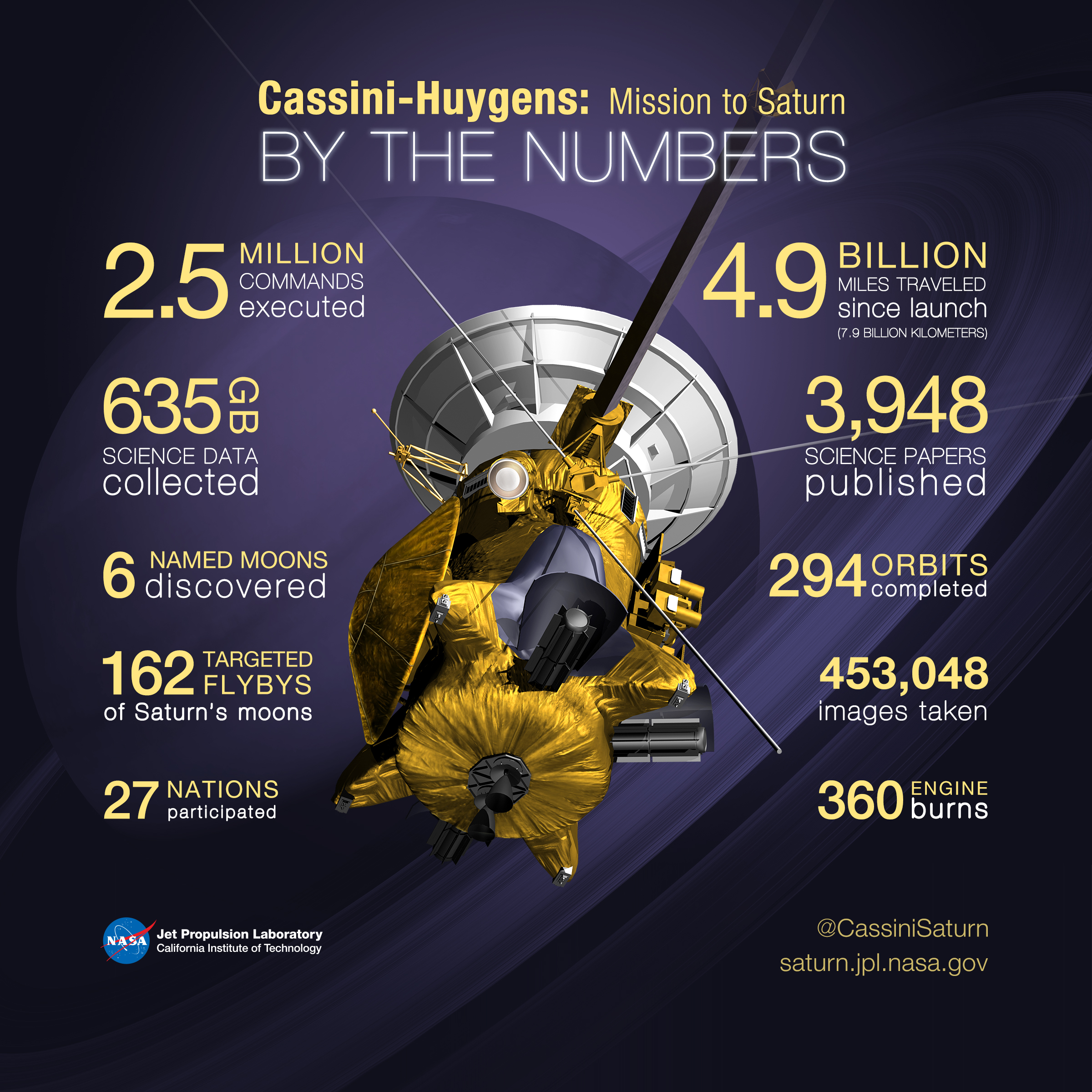
The Cassini orbiter was launched from Cape Canaveral, Florida on October 15th,1997. This was a joint effort between NASA, ESA (European Space Agency), and ASI (The Italian Space Agency). The mission was to study and explore Saturn and its system of rings and moons. The trip to Saturn would take seven years and the totality of the mission from the 1997 launch to 2017 plunge into Saturn would be 21 years. A majority, 13 years, of those years being spent studying the ringed planet and its moons. Saturn is approximately 75,000 miles in diameter which is nearly 10 times as large as Earth meaning 750 Earth sized planets could fit into Saturn. Saturn has a mass that is 95 times more massive than Earth. Saturn is roughly 1 billion miles from Earth, when the two are at their closest with respect to each other, which is 7 astronomical units (AU). One AU is the equal to the distance from the center of the Earth to the center of the Sun.
Discoveries of the Mission
The data, images, and samples collected by Cassini provided scientists with a wealth of information and knowledge about the ringed planet, the ring systems and its many moons. The mission revealed a large hexagon shaped jet stream at one pole of the ringed planet. “The hexagon is just a current of air, and weather features out there that share similarities to this are notoriously turbulent and unstable. A hurricane on Earth typically lasts a week, but this has been here for decades — and who knows — maybe centuries.” said Andrew Ingersoll of the Cassini Imaging Team. The Huygens probe made the first ever landing onto a moon in the outer solar system when it landed on Titan On January 14th, 2005. Titan was found to have rivers, lakes, and oceans. Titan has a thick nitrogenous atmosphere that may be similar to early Earth’s atmosphere. Six new moons were discovered to be orbiting Saturn which brings the total number of known moons orbiting Saturn to 82. With the discovery of these new moons Saturn now boast of having the most moons of any planet in our solar system.
Saturn’s Ring System
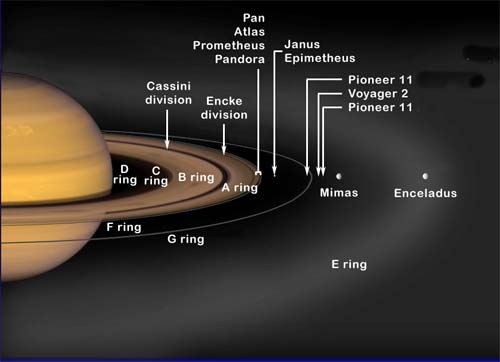
The breathtaking rings of Saturn were found to be made up of mostly frozen water mixed with space dust as well as rocky meteoroids. The particles making up the rings vary from the size of a grain of sand to the size of mountains. Vertical structures, which rise as high as 2 miles were seen on the B-ring of Saturn ring system. The rings reach an impressive 175,000 miles from the planet yet the average vertical height is only 30 feet in the main rings.

It turns out that the ringed planet did not always have these beautiful rings. This means the rings are younger than the planet itself. The rings are thought to have been created when asteroids, comets, or other bodies smashed into the planet sometime in the last 100 million years making the rings much younger than Saturn itself. The host planet for these rings was formed approximately 4.5 billion years ago. The Cassini mission also provided evidence that Saturn is losing its rings as the particles making up the rings are being pulled into the planet under the influence of Saturn’s strong magnetic field. Scientists predict that the ring structure will be gone in 100 million to 300 million years.
A Little about Enceladus
Saturn’s moon Enceladus, the sixth largest moon of Saturn, was discovered in 1789 by astronomer William Herschel. Enceladus is roughly 790 million miles from Earth and orbits its host planet, Saturn at an average distance of 148,000 miles. By way of comparison our moon orbits the Earth at an average distance of 238,000 miles. Enceladus is one-seventh the diameter of our own moon and much less massive than our moon. Here is a link comparing Enceladus to our own moon: https://solarsystem.nasa.gov/moons/saturn-moons/enceladus/by-the-numbers/
Enceladus boasts five distinct physical features including craters, cracks in the surface, ridges and fissures. Scientists speculate that the presence of cracks and ridges is evidence that the core of Enceladus is still a liquid composition. The smooth plains on the surface of the moon seem to indicate that there was water flowing from deep in the core to the surface. So how does the water make it from deep inside the moon to the surface? As it turns out there are a system of hydrothermal vents that connect to an ocean of saltwater below the surface. Scientists settled on this idea based on the presence of silica nanograins found in the E-rings. These nanograins can only be generated at temperatures above 90 degrees Celsius in areas where liquid water and rock interact. In 2005 scientists discovered that there were plumes of water shooting out from its south pole. These plumes are ejecting water which is continuously shot out into space at 800 miles per hour traveling hundreds of miles to the planets E-rings.
What’s so Special about Enceladus?
So what makes this moon special as compared to the other 81 moons orbiting Saturn? The major finding of Enceladus is not simply that it has an abundance of water, the moon Titan is believed to also have water, but it is what is contained in the plume that was surprising. Cassini was able to directly take samples of the plume from Enceladus as well as from the E-ring of Saturn. The results were stunning. The water contained a mixture of volatile gasses, water vapor, carbon dioxide, carbon monoxide, and organic materials. Similar results were obtained from both the samples taken from the E-ring of Saturn and the icy moon Enceladus.
“This is the first-ever detection of complex organics coming from an extraterrestrial water world,” said planetary scientist Frank Postberg from the University of Heidelberg in Germany. While no life forms have been detected yet scientists have not ruled out the possibility of finding life deep with in the moon or in the rings of Saturn. Scientists noted that most of the larger organic molecules were found in the E-ring. Speculation is that sunlight may have triggered chemical reactions in space which resulted in the complex organic molecules.
So What’s Next?
According to Potsberg the next logical step would be to go back to Enceladus “and see if there is extraterrestrial life.” Plans are already underway for a 2022 mission to the moons of Jupiter to search for habitable conditions on the icy moons containing subsurface oceans. With respect to returning to Saturn’s moon to search for life Potsberg notes “Nowhere else can a potentially habitable extraterrestrial ocean habitat be so easily probed by a space mission as in the case of Enceladus.” When the Cassini mission was close to termination a deliberate decision was made to send Cassini spiraling into the planet to avoid any accidental cross contamination with Enceladus. This suggests that a return trip to the moon was already being discussed and that the researchers wanted to leave no doubt that, if in fact, life was found on Enceladus it was not delivered by Cassini. Will the first extraterrestrial life be found on Enceladus? No one knows for sure but it is an extremely exciting possibility.

 Neville’s Phantastic Physics Phun