The red supergiant, Betelgeuse has been in the news recently because of its unexpected behavior. Astronomers have noted that since October 2019 the red supergiant had been dimming and the star is now less than 40% of its normal brightness. Before we discuss what this means for the star let me introduce you to Betelgeuse.
Betelgeuse is between 640-724 light years from Earth and is the alpha or brightest star in the constellation Orion. Betelgeuse and Bellatrix make up the shoulders of Orion, the Hunter. Betelgeuse used to hold the distinction of being one of the top 10 brightest stars in the sky but has fallen to below 20th since it began dimming in October 2019. Betelgeuse is believed to be between 9 and 10 billion years old with a solar mass that is 12 times more massive than our sun.
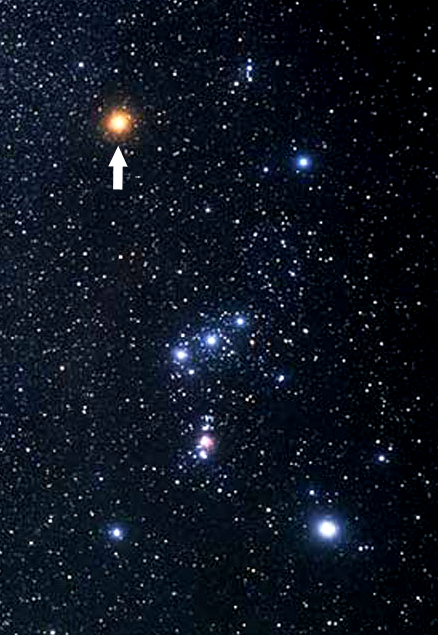
Red Supergiants
So what is a red supergiant star? Red supergiants are stars of a specific size that are nearing the end of their lives. These stars spend only about 10% of their lives as red supergiants while the prior 90% is spent as a massive main sequence star. These stars have a mass greater than 10 solar masses meaning these stars have more than ten times the mass of our sun. In these stars most of the hydrogen fuel has been exhausted and the core stops producing energy and gravity causes the core to contract. The layer of the star surrounding the core contracts and heats up to a high enough temperature to start fusing hydrogen to helium. The outer parts of the star expand as a result of the star burning hydrogen. The star is producing more energy than necessary to offset the collapse due to gravity. The outer layer expands to several hundred solar radii and the surface temperature cools as a result of the increased surface area. This temperature decrease gives the star its reddish color.

The Dimming of Betelgeuse
Betelgeuse belongs to a class of stars called Cepheid variables or variables. These types of stars, according to universetoday.com “are essentially stars that experience fluctuations in their brightness (aka. absolute luminosity)”. So this means that some dimming from Betelgeuse is to be expected. Betelgeuse is considered to be a semi-regular variable star or slow irregular variable star which means its brightness or luminosity fluctuates in fairly predictable cycles. One cycle lasts for approximately 420 days, a second longer cycle lasts for close to six years, and a third cycle lasts somewhere between 100 and 180 days. The current reduction in brightness is larger than expected which has led to questions about what this means for the red supergiant. Some scientists think that this dimming is simply an extended dimming period lasting longer than the 420 day cycle while others speculate that Betelgeuse may be heading towards its ultimate demise, a supernova explosion. The European Southern Observatory (ESO) posted a video comparing the luminosity of Betelegeuse from December 2019 to January 2020, you can view the video here: https://www.youtube.com/watch?reload=9&v=o1ls7Gr9LTE According to ESO “this video shows the star Betelgeuse before and after its unprecedented dimming. The observations, taken with the SPHERE instrument on ESO’s Very Large Telescope in January and December 2019, show how much the star has faded and how its apparent shape has changed.”
What is a Supernova and When Might it Occur for Betelgeuse?
According to nasa.gov, a supernova is “the explosion of a star. It is the largest explosion that takes place in space.” There is some speculation that Betelgeuse is nearing the end of its life and may go supernova in the near future. Let’s be clear about the meaning of “near future”. In our everyday life the “near future” may be a few days, a few weeks, maybe even a few months. Is astronomical terms, the “near future” may mean anywhere from a few thousand years to over a hundred thousand years. It is all based on your reference. Astronomers are comparing a few thousand years to the age of the universe which is estimated to be nearly 14 billion years old.
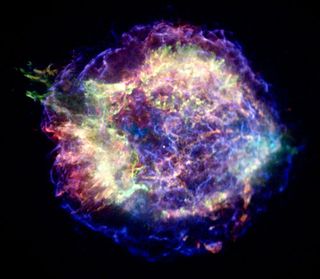
(Image: © NASA/CXC/MIT/UMass Amherst/M.D.Stage et al.)
When the iron core reaches its Chandrasekhar mass which is about 1.4 times the mass of our sun or 1.4 Solar masses, the pressure of the core can no longer hold up against gravity and the iron core begins to collapse. During this collapse the electrons and iron nuclei get mashed together and electrons combine with protons in the nuclei to form more neutrons. This combing of electrons and protons results in a decrease in pressure which speeds up the collapse. The collapse of the core takes a mere few thousandths of a second.
As the core of the star reaches a size of around 31 miles the core contains a gas consisting of 70% neutrons and 30% protons with a temperature of 100,000,000,000 K. This object is now a proto-neutron star. The outer layers are continuing to fall into the core and a stream of neutrinos are flowing out of the proto-neutron star. This flow of neutrinos results in an enormous release of energy causing the outer layers of the star to be blown away. This flow of neutrinos is responsible for 99% or this enormous energy and light is the remaining 1% of the energy.
The brightness or luminosity of a supernova is 10 billion times greater than that of our sun. A supernova may outshine its own galaxy for several days. So why aren’t we seeing supernovas all the time? Shouldn’t we be able to detect them by the enormous luminosity? Scientists have found that core collapse supernova only occur at a rate of 1 supernova per century per galaxy.
Types of Supernova
There are several different types of supernova. They are classified by the type of light that is emitted by star. This can be thought of as the chemical signature of the star. These signatures help astronomers determine what elements are present in or created by the star.
The first is called type 1a supernova. Scientists believe that this type of supernova occurs when white dwarf stars, those stars who had masses less than 1.5 times the mass of our sun, acquire more mass than its internal pressure can withstand so it heats up and goes supernova. A star that became a white dwarf would not normally be massive enough to go supernova. The white dwarf is thought to have gained the mass from colliding with another white dwarf of from a companion red giant.
The next type of supernova is the type 1b supernova. In this case the star had a mass at least 25 times the mass of our own sun. It certainly is massive enough to go supernova. This type of star is thought to have shed material from its outer envelope later in life which is why there is little hydrogen in its spectrum. This type of supernova does show helium in its spectrum.
Type 1c supernova contain very little hydrogen and helium and are formed the same way the type 1b supernova are formed. The difference between type 1b and 1c is the lack of helium found in the 1c supernova.
Type II supernova or core collapse supernova contain large amounts of hydrogen and helium in its spectrum. It is believed that large stars with masses are larger than 8 times the mass of our sun undergo this type of supernova. The massive explosion results in the creation of a blackhole or a neutron star. This is the type of supernova a red supergiant, such as Betelgeuse, will undergo at the end of its life.
Why Do We Care about Supernovas?
It turns out stars only produce elements up to iron through the fusion reactions in their core. So that begs the question, where do elements heavier than iron come from? Well, the extremely large amounts of energy and the enormous temperatures associated with supernova explosions can cause fusion of the heavier elements. These heavier elements are shot out through the universe during the supernova explosion. Many of the elements we have found here on earth were created in the core of a star during a supernova. The elements that travel through the universe eventually are used to create planets, new stars and anything and everything else in the universe. According to nasa.gov/audience/forstudents “one kind of supernova has shown scientists that we live in an expanding universe, one that is growing at an ever increasing rate.” So that’s why you should care about supernovas!

Courtesy of herschel.jpl.nasa.gov
 Neville’s Phantastic Physics Phun