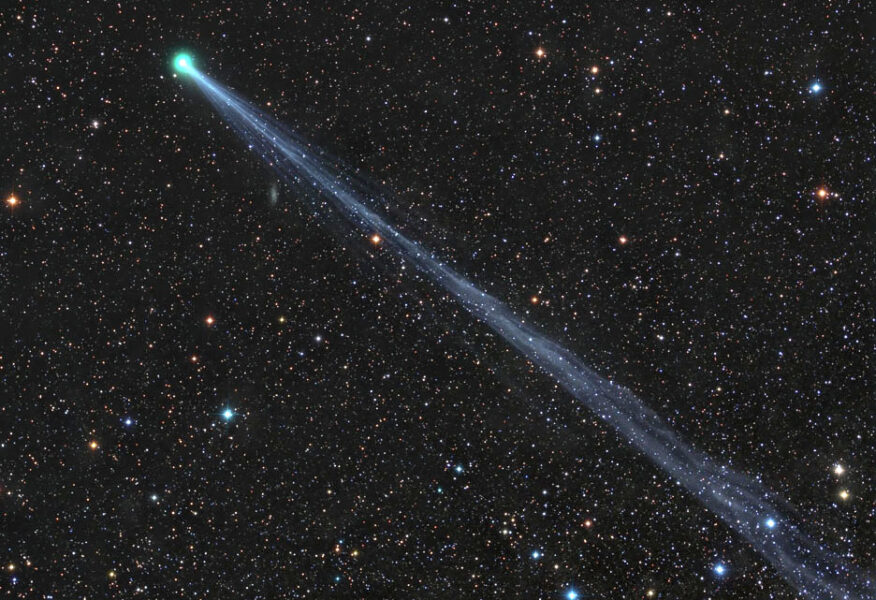
On March 25th amateur astronomer Michael Mattiazzo discovered Comet SWANN (C/2020 F8) using the Solar and Heliospheric Observatory’s SWAN (Solar Wind Anisotropies) camera. (skyandtelescope.org) Viewers in the Northern Hemisphere should be able to view the Comet SWAN beginning in Mid May. The discovery of this previously unknown comet got me thinking a bit about these celestial objects. This comet has only been recently discovered so we don’t yet know much about it. I wanted to give a brief description of comets and talk a little about what we do know about these fascinating objects.
According to solarsystem.nasa.gov “Comets are cosmic snowballs of frozen gases, rock and dust that orbit the Sun.” This certainly doesn’t seem like much to get excited about. Let’s look a little closer at these “cosmic snowballs”. Think back to your days in middle school and high school science class when you learned about atomic structure. One of the things that stood out to me is how similar each atom was varying only by number of electrons and/or neutrons. It was easy to draw an atom of any element using the Bohr model because they all had the same basic structure, a positively charged nucleus containing some protons and neutrons, and electrons with their negative charges orbiting the positively charged nucleus. It turns out that active comets which are close to the sun have all have similar structure as well, meaning they all have the same component parts but may vary from comet to comet in size, composition, and place of origin.
The Structure of Active Comets
The structure of active comets all contain several distinctive features. The nucleus of a comet is the portion which contains mostly ice and gas with trace amounts of dust and other particles and is generally 1 to 10 km in size. It is possible, however for a comet to have a nucleus of up to 100 km. The nucleus of an active comet is mostly in a solid state and fairly stable. The coma is a cloud of water, carbon dioxide and various other gases which are converted directly from solid to gas as they are heated as the comet approaches the sun. This part of the comet may be over a thousand times larger than the nucleus. The nucleus along with the coma form the head of the comet. The hydrogen cloud or envelope is yet another feature of comets, this is an extremely large cloud of hydrogen which envelopes the comet. This cloud may be in the vicinity of millions of kilometers in diameter. Active comets that are nearing the sun have two distinct tails. The dust tail, which is the most obvious and visible feature to the unaided eye, is composed of mainly dust and other gases and may be upwards of 10 million kilometers long. Interestingly, the dust tail always points away from the sun. The dust tail reflects light from the sun making it the most visible portion of the comet. The second tail, the ion tail is composed of plasma and other particles related to the comets interaction with the solar winds associated with the sun. This tail may be much longer than the dust tail reaching lengths of several hundred kilometers.
![28+ [ Comet Diagram ] | schematic diagram of a typical comet the ...](https://lh3.googleusercontent.com/proxy/lfjVzWlBag2U_iez9EN-HISADSg8fNyMTNG7Nb9kutvXMubRqFdrN8tdKAkW2W6QdGa8RJQbwHRkhduv7-RTRnr7KK8TGrGL3g7hWOdC)
The Path of a Comet around the Sun
Comets, like planets orbit around the sun. The orbit of a comet follows a much more elliptical path than do planets. The length of time it takes an object to complete one orbit is called a period. The period of the Earth’s rotation around the sun is 365.25 days and the period about its axis is 23 hours and 56 minutes. The period of the moon is 27 days which is the amount of time it takes to orbit the Earth. Comets in general have much longer periods. Any comet with a period of less than 200 years is referred to as short period comets. These comets originate from the Kuiper Belt. In case you were wondering, the Kuiper Belt is “a donut-shaped region of icy bodies beyond the orbit of Neptune. (solarsystem.nasa.gov) If the period of a comet is greater than 200 years it is called a long period comet and originates from the Oort cloud which is “is believed to be a giant spherical shell surrounding the rest of the solar system and is the most distant region of our solar system. Even the nearest objects in the Oort Cloud are thought to be many times farther from the Sun than the outer reaches of the Kuiper Belt.” (solarsystem.nasa.gov) Halley’s comet is perhaps one of the most famous comets of all time and has a period of 76 years making it a short period comet. The Hale Bop comet is a long period comet with a period of over 2500 years.
An article featured on Space.com, author Joe Rao wrote about the period of comet SWAN where he stated “for fun, I fed its orbital elements, which includes the eccentricity of its path around the sun, into an orbital simulator. My simulation suggests Comet SWAN is traveling around the sun in a period of about 25 million years. (space.com) The discovery of this comet is so new that the actual period of orbit remains to be seen but this certainly would be a fascinating development. We would be the very lucky few of humankind to be able to view this very long period comet.

How to View Comet SWAN
The best time to view SWAN will be in the evening hours or just before dawn beginning on May 23rd until June 10th according to skyandtelescope.org. The comet currently is visible using binoculars as well as the unaided eye to those in the Southern Hemisphere. Curious stargazers wishing to view the comet with the unaided eye in the Northern Hemisphere shouldn’t have to wait much longer as it will be visible to you by late May. The comet will reach perihelion, which is its closest distance to the sun around May 27th. At perihelion the SWAN comet will be roughly 64 330 000 km from the sun and the closest it will be to Earth will be on May 12-13th when it will be a mere 83 330 000 km from Earth.
Stay tuned to your favorite astronomy magazine or website to learn more about this newly discovered comet. Michael Mattiazzo, the amateur who discovered this comet has discovered a total of 8 comets dating back to 2004. Keep your feet on the ground, eyes open and head to the heavens and maybe you will discover the next comet or other astronomical object.

 Neville’s Phantastic Physics Phun