
Neutron stars: One of the universe’s most exotic and bizarre objects.
Most people are familiar with black holes and understand that they are created when a massive star, one that is greater than 30 times the mass of the sun, dies. Stars that are similar in mass to our sun ranging from about .3 times the mass to 8 times the mass of the sun become red giants when they die. So what exactly is a neutron star? Neutron stars are the result of a collapsed star that is approximately 25-30 times the mass of our own sun. The star goes supernova at the end of the its life. When a star runs out of nuclear fuel and nuclear fusion within the core slows, the result is a decrease in pressure. This drop in pressure causes the star’s core to compress under the strain of it’s own gravitational forces. Without the offsetting pressure to maintain the stars structure the core collapses in a few thousandths of a second.
The core temperature of a star that has gone supernova may exceed billions of degrees Celsius or 100 000 000 000 K. The star undergoes a fantastic explosion that is called a supernova. The luminosity of a supernova may be up to 10 billion times greater that of our own sun. The supernova may even outshine its entire galaxy for a few days. The rate at which core collapse supernova occur is approximately 1 supernova per century per galaxy.
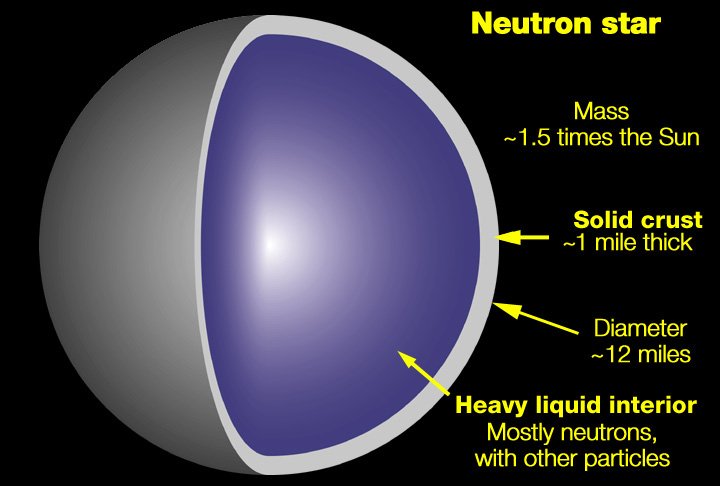
Once a star within the 25-30 times the mass of our sun has gone supernova, what happens to its left over core? One possibility is that the core stabilizes and becomes a neutron star. A neutron star is thought to be composed of a super-fluid an exotic friction free state of matter of neutrons. The electrons and protons inside the star have been compressed to create the neutrons found in the super-fluid state. A neutron star may be only 12 miles in diameter and have a mass of 1.3-2.5 the mass of the sun. So how did a star that was 25-30 the mass of our sun end up being a core that is only 1.3-2.5 times the mass of our sun? When the core of the star is collapsing the outer layers of the star get removed due to the large amount of energy that is released by the star. A large majority of the energy released by the star is in the form of neutrinos (99% of the energy) while the remaining energy released is in the form of light. The matter within a neutron star is so densely packed into the 12 mile diameter that a sample of the neutron star the size of a cube of sugar would weigh 1 billion tons.
Why should we care about neutron stars?
Scientists have long wondered where elements heavier than iron were created. Dying stars produce elements up to iron but little was known how the heavier elements were produced. As it turns out during a supernova, heavier elements including gold and platinum may be produced. In order for these heavier elements to be produced a neutron rich environment is needed. A process called ‘r-process’ or rapid neutron capture process is used to create these heavier elements. Neutron stars, as you might guess from the name, provide just such a neutron rich environment. One theory suggests that the merger of neutron stars is a mechanism for r-process and the creation of these heavy elements.
Interesting facts about neutron stars
- The gravity of a neutron star is approximately 200 billion times greater than gravity on Earth.
- The magnetic field of a neutron star is approximately 1 trillion times greater than on Earth.
- The electric fields of a neutron star are 30 million times more powerful than a bolt of lightning.
- Neutron stars rotate several hundred times per second with the fastest known neutron star, PSR J17482446ad, rotating over 700 times per second.
- There are about 100 million neutron stars in the Milky Way galaxy.
- There are 2 known neutron stars to host planets.
 Neville’s Phantastic Physics Phun