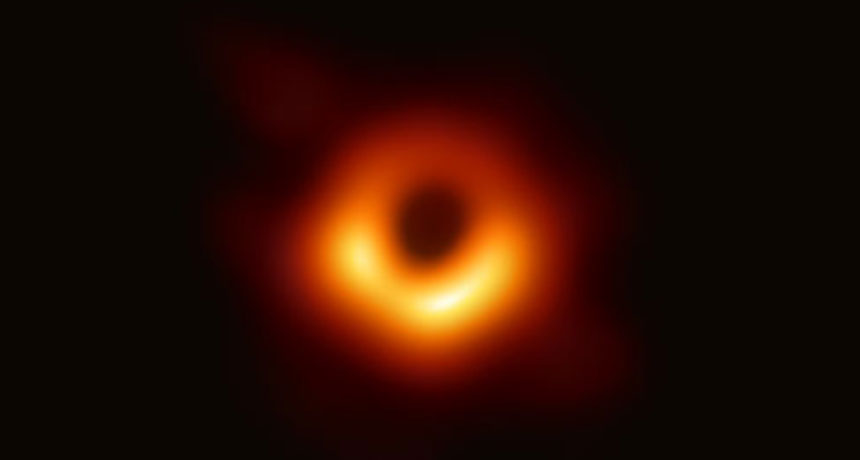
Most of us have some idea about black holes. How much you know about these objects likely varies on how interested you are in astronomy as well as your scientific background. Science fiction has long portrayed black holes as evil forces of nature bent on destroying mankind. Movies and books often portray these celestial bodies as monsters traveling across the universe eating up everything in its path. Based on these characterizations you might predict the end of our planet will most likely be due to an encounter with a rogue black hole. So before we start preparing for our demise via black holes lets all take a deep breath and discuss the facts about these things.
Escape Velocity
The first thing we should discuss is something that my students often recite whenever the topic of black holes is mentioned. They will automatically say “it is something so dense not even light can escape it” while this is correct what does it actually mean? In order for something, be it light or a rocket, to leave a planet or anything with a gravitational field the object must over come what is called escape velocity. So what does it actually mean? Escape velocity is the speed needed for an object to overcome the gravitational attraction of a planet, or other body. The gravitational attraction can be calculated by the following equation:

Where F is the gravitational attraction, G is the universal gravitational constant and is equal to 6.67 x 10^-11 m^3/kg * s^2, m1 and m2 represent the masses of the planet and the object being attracted to it and r^2 is the distance between the two objects. You can use this formula to calculate the gravitational attractive force between any two objects in the universe. In order to break free from the gravitational attraction an object must be traveling fast enough to overcome this force. Escape velocity can be calculated by the following formula:

With this equation, which is derived from the kinetic energy formula and the Universal Law of Gravitation, you can calculate how fast something must travel to leave the planet. An object must be traveling at a rate of 11 km/s in order to leave the Earth. If, for example, one found them self on the surface of a neutron star the escape velocity would be 165,000 km/s.
So we have this equation why can’t we use it to calculate the escape velocity needed for light to leave a black hole? As it turns out this question was answered by Reverend Jon Mitchell in 1783. He was able to determine that, as a bizarre consequence of Newton’s law of motion, an object with the same density as the sun but 500 times its radius would have an escape velocity greater than the speed of light. So for any object, such as a black hole, that has an escape velocity faster than the speed of light it means nothing can escape that object. The more massive the object is and the smaller the object has been compressed the greater the escape velocity.
Features of Black Holes
Another feature of black holes is the event horizon. This is the boundary between the black hole itself and the space around it where objects may safely reside. Once an object has crossed over the event horizon the escape velocity exceeds the speed of light and therefore, no object can escape from it.
According to astronomy.swin.edu “The Schwarzschild radius is the radius of the event horizon surrounding a non-rotating black hole.” The equation for the Schwarzschild Radius is
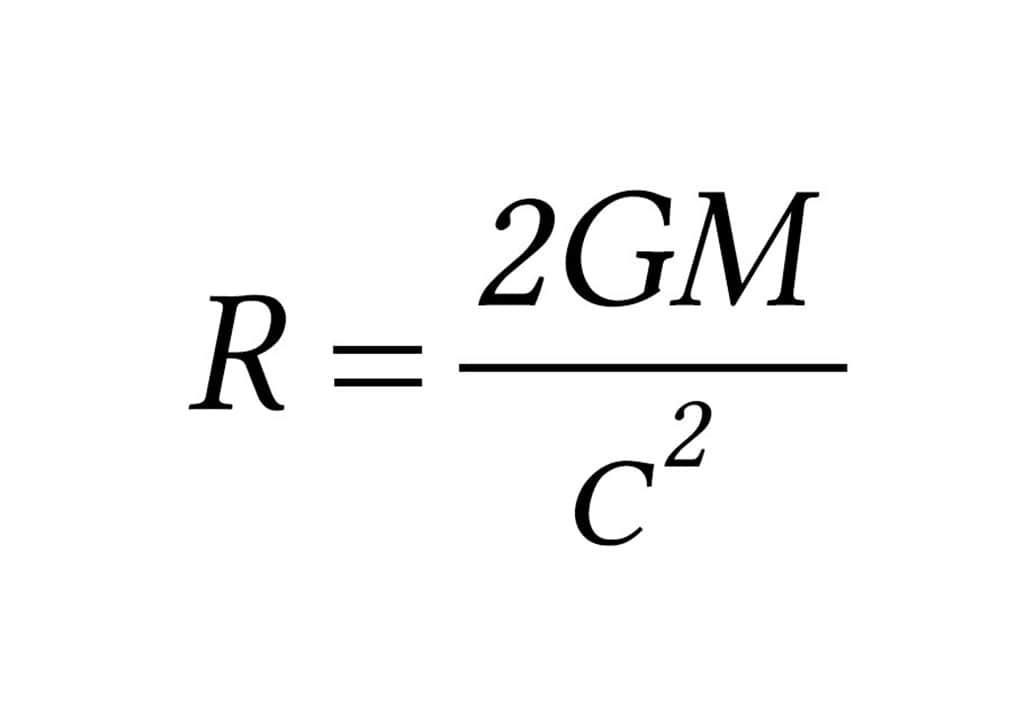
Any object with a physical radius smaller than its Schwarzschild radius will become a black hole. This quantity was first derived by Karl Schwarzschild in 1916: The Schwarzschild Radius is the size an object must become in order for its escape velocity to exceed the speed of light. In order for the Earth to become a black hole it would need to be compressed down to the size of 0.9 cm or 1/3 of an inch and the sun would need to be compressed to down to 3 km or just under 2 miles. So as we will see later most stars in the sky do not become black holes at the end of their lives.
There is a point inside the the black hole that general relativity tells us has infinite density and curvature this point is termed the singularity. According to Kip Thorne the singularity is “the point where all laws of physics break down”. Some scientists have suggested that an, as of yet, unknown combination of classical physics and quantum physics may be needed to more accurately describe the behavior and features inside black holes.
Often times black holes will be depicted with material swirling around it prior to being sucked into the black hole. This material is a combination of gas, dust, and other material making up what is called an accretion disk. Physicsoftheuniverse.com defines an accretion disk as “material, such as gas, dust and other stellar debris that has come close to a black hole but not quite fallen into it, forms a flattened band of spinning matter around the event horizon…” We are able to see the accretion disk because the particles which make it up are spinning at a high rate of speed releasing heat, gamma rays and x-rays as the particles collide with each as a result of the black holes large gravitational force.

So How are Black Holes Formed?
Stellar black holes are formed when a star greater than 25 solar mass, that is 25 times more massive than the sun collapse in on themselves and goes supernova. When the internal pressure can no longer withstand the gravity, stars of this size collapse until all the matter is within the Schwarzschild radius. The resulting supernova ends up as a stellar black hole. These stellar black holes are roughly 3-100 solar masses or 3 to 100 times the mass of the sun.
A second way stellar black holes are formed is when neutron stars have exhausted their magnetic fields and devolve into small (2-5 solar mass black holes) black holes. These black holes are much smaller than those created by stars that are greater than 25 solar mass. As it turns out it is a relative rarity that stars become black holes upon their death. Most stars, including our own sun, are too small to wind up as stellar black holes.
Supermassive black holes are thought to be the at the center of galaxies including our very own Milky Way Galaxy. These black holes are 100,000 times the mass of the sun. Scientists believe that the enormous mass of these black holes is directly related to their location at the center of galaxies. These galaxies provide billions of stars and other material to feed the black hole so that it can grow quickly over time. Galaxies tend to collide with other galaxies which also allows for the supermassive black holes to grow even larger.
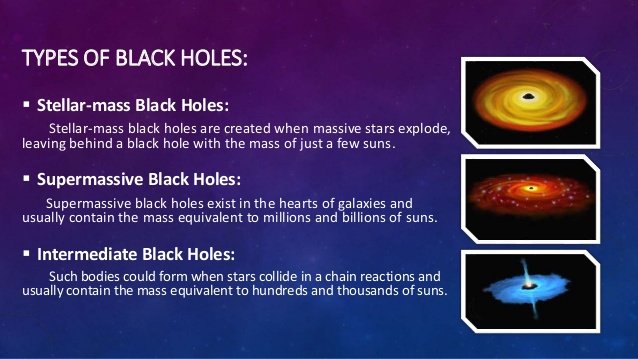
Intermediate black holes which may range anywhere from 100 to 100,000 solar mass are created by the merger of other smaller black holes to create a single larger black hole or when a black hole “eats” large amounts of matter around it to increase its mass. Chain reactions caused by the collision of stars is another way that intermediate black holes are thought to be created.
Here is a video that combines many of the topics we’ve already discussed black hole features and how black holes are formed: https://www.youtube.com/watch?v=brmjWYQi2UM
How Do We Know Black Holes Exist?
Since we are unable to see a black hole, how do we know they exist? A fair and interesting question to be sure. Well, we can detect their effects on nearby objects such as gas and stars. Stars that orbit a black hole have a characteristic “wobble” when we observe them. The wobble is caused by a massive object exerting a gravitational pull on the object. The object must be very massive to exert a noticeable effect on its companion star. Scientist can estimate the mass of the black hole by the effect it has on its visible companion. We are also able to detect X-rays from the discs of gas falling into a black hole. This may happen when material from a companion star fall into a black hole for example. Supermassive black holes are thought to eject materials in the form of high speed jets and radio emissions.
Gravitational lensing was used to determine that a black hole had traveled between Earth and a star called MACHO-96-BL5.
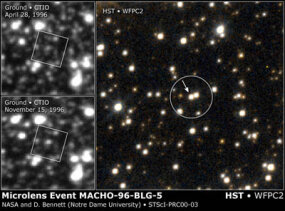
According to spacetelescope.org the image above “Hubble Space Telescope looked at the object, it saw two images of the object close together, which indicated a gravitational lens effect. The intervening object was unseen. Therefore, it was concluded that a black hole had passed between Earth and the object.”
So Why Do We Study Black Holes?
Scientist study black holes to learn more about the early universe as some of these black holes were likely created very soon after the big bang. The idea that the laws of physics breakdown inside a black hole pose a challenge for scientists. If our known laws of physics don’t operate at the singularity then what is really going on inside a black hole? New theories such as loop quantum gravity are being investigated to see if they apply at singularities.
Shep Doeleman, senior research fellow at Harvard University and director of Event Horizon Telescope (EHT) stated in the Out There issue of Popular Science: “There’s no environment in the universe like a black hole. Being able to see such an object gives us a ‘natural laboratory.’ We can test long-standing theories about how objects move through space—like Einstein’s general relativity—by watching gravity-driven warps in spacetime impact how light travels. We can also study how black holes help shape the universe by sucking up matter.” And that’s why we study black holes!
 Neville’s Phantastic Physics Phun