Credit: OSR.org A conceptual depiction of a black dwarf star
The ultimate fate of a star once it is has died is dependent upon the mass of the star during its lifetime. A star in general falls into one of the following mass categories: low mass, medium mass, or high mass. The determination of a star’s mass occurs at birth as the star is forming. Stars do not acquire mass throughout their lives and do not grow from low mass star to high mass star for example.
You may be familiar with the what happens to a star once its fuel has run out and it is nuclear fusion is no longer occurring in its core. High mass stars generally have the most spectacular death as they transition to a red supergiant before going supernova and eventually reaching their final fate.
A high mass star’s eventual fate will either be as a neutron star if it has a mass of 1.4 to 3 times the mass of the sun or as a blackhole if the star has a mass larger than 3 times the sun. An average star will end its life as a red giant shedding its layers to become a planetary nebula. The red giant core will settle in as a white dwarf. This may not seem like a new revelation but there is a theory that takes the white dwarf to one final stage. We have discussed the life cycle of stars and the death of stars in other posts. Today we want to talk about a very specific and theoretical star known as a black dwarf. Have you ever heard of one? No? Well don’t worry most people haven’t heard of them and absolutely nobody has seen one and no one in our lifetime ever will.
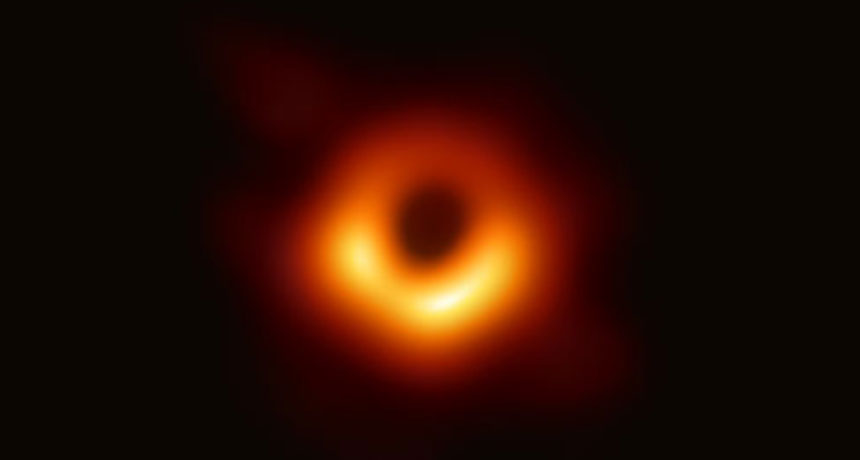
A black dwarf is a theoretical result of a white dwarf cooling down to a point where it no longer emits light or heat. The object still retains its mass in this phase but does not emit any radiation. You may be thinking to yourself that if it emits no light or heat that is why no one has ever seen one. This might appear to be similar to a black hole which had never been observed until the Hubble Space Telescope (HST) produced the first ever image in 2019. It is true that we would not be able to directly observe a black dwarf but the lack of light or heat is not why we haven’t observed one of these objects yet.
It turns out it takes a long time for a white dwarf to cool down enough to enter the black dwarf phase. A really long time. Scientists believe it takes trillions of years for a white dwarf to become a black dwarf. According to Scientific American, it takes “few billion years” for a white dwarf to cool down to the surface temperature as our sun. What that means is that not one black dwarf exists at this moment in time. There simply hasn’t been enough time for one to form. If you take the age of the universe to be around 15 billion years old you can understand why no black dwarfs exist yet. Here is a short video that describes what will eventually happen to our sun as it becomes a black dwarf: https://youtu.be/1mXueDqxvFs
One theory suggests that black dwarf stars eventually “break down and disperse into space” according to Universe Guide. Another idea is that very massive black dwarfs, those between 1.2 to 1.4 solar masses may result in a supernova. According to the article “Fusion can still occur at very cold temperatures – it just takes an incredibly long time and requires some help from quantum mechanics. Eventually, those fusion products should build up enough to choke the black dwarf into a supernova, in a similar way to more massive stars. This explosive fate awaits as many as one percent of all stars shining today,” So if you’d like to wait around and see when the last black dwarf is projected to go supernova you’ll be waiting for a while. How long? Try 10^32,000 in the future according to the article.
If you have ever found yourself awe struck by the beauty and mystery of stars in the night sky you are not alone. The night sky and stars in particular have fascinated and inspired people since the dawn of man. Stars have been used to help sailors navigate the ocean, been used to predict the harvest, and even for religious purposes. Science fiction and pop culture are full of ideas about traveling to the stars or “shooting for the stars” and you can even find registries online that will let you name a star. So a logical set of questions you may have asked yourself are how are stars created, how long do they live, and how do they die?
Fun Facts about Stars
Before we dive into answering those question let’s discuss some facts about stars. Some of these you may know and others may be news to you. There is only one star, our sun, in the our solar system but there are over 100 billion stars in the Milky Way galaxy. The Alpha Centauri system contains the three closest stars, other than the sun to Earth. The stars in this system are Alpha Centauri A, Alpha Centauri B, and Proxima Centauri. Alpha Centauri A & B are a binary pair of stars with an average distance of 4.3 light years from Earth while Proxima Centauri is roughly 4.22 light years from Earth.
Let’s describe some of the terms discussed above. A binary pair can be defind as “… two stars orbiting a common center of mass. The brighter star is officially classified as the primary star, while the dimmer of the two is the secondary (classified as A and B respectively).” (https://www.space.com/22509-binary-stars.html) Despite the term year appearing in the word, a light year is not a measure of time but rather a measure of distance. A light year is the distance that light can travel in one year. Light travels at an incredibly high rate of speed, how fast you ask? Try 300,000 kilometers per second or 186,000 miles per second. So a light year is approximately 9 trillion kilometers or 6 trillion miles. So if we could travel a 186,000 miles per second it would take us 4.3 years to reach Alpha Centauri A & B.
Credit:universetoday.com
How are Stars Formed
With over 100 billion stars in our Milky Way galaxy alone an obvious question is where did these stars come from and how are they formed? Well I’m glad you asked. Stars are formed in stellar nurseries called nebula. According to https://spacecenter.org/what-is-a-nebula/ a nebula is “an enormous cloud of dust and gas occupying the space between stars and acting as a nursery for new stars.” These regions can be formed from the death of other stars via a supernova or from interstellar dust and gas found in the universe. The nebula can be some of the most breath taking features in the night sky.
Horse Head Nebula Credit: noirlab.edu
The life cycle of a star is determined by the mass of the star itself. Stars with a greater mass end up having a shorter lifetime than other stars. So what determines the mass of a star? As it turns out, the mass of a given star is a result of the amount of matter available to it in the stellar nursery or nebula where it is being formed. Nebula provide gas and dust which slowly begins to collapse under its own gravity. As the amount of matter begins to increase the temperature and pressure also increase and the cloud begins to spin about the center of mass. This is the birth of a protostar. (also known as a T Tauri star) According to science.nasa.gov a protostar is the “hot core at the heart of the collapsing cloud that will one day become a star.” As the protostar continues to heat up it reaches a temperature of 15,000,000 K at which time nuclear fusion begins converting hydrogen to helium. When these atoms of gas are fused together the result is the release of an extremely large quantity of energy. This release of energy is a consequence of Einstein’s famous theory E=mc^2 which states that the amount of energy obtained from an object is equal to the mass of the object multiplied by the speed of light squared, an incredibly high number. Here is a short video clip from the Science Channel’s How the Universe Works “A Star is Born” episode. It can take close to 50 million years for an average star, such as our sun to form!
In order for the nuclear fusion to occur a star candidate must have a minimum mass of .08 the mass of the sun. Objects that have a mass that is between 15 and 75 times the mass of Jupiter are known as Brown dwarfs. Often called failed stars, Brown dwarfs are too large to be a planet and too small to be a star. It is believed that brown dwarfs form in the same way as stars do but these objects don’t have enough mass to allow for nuclear fusion to occur.
Image credit: astromart.com
The Life and Death of a Star
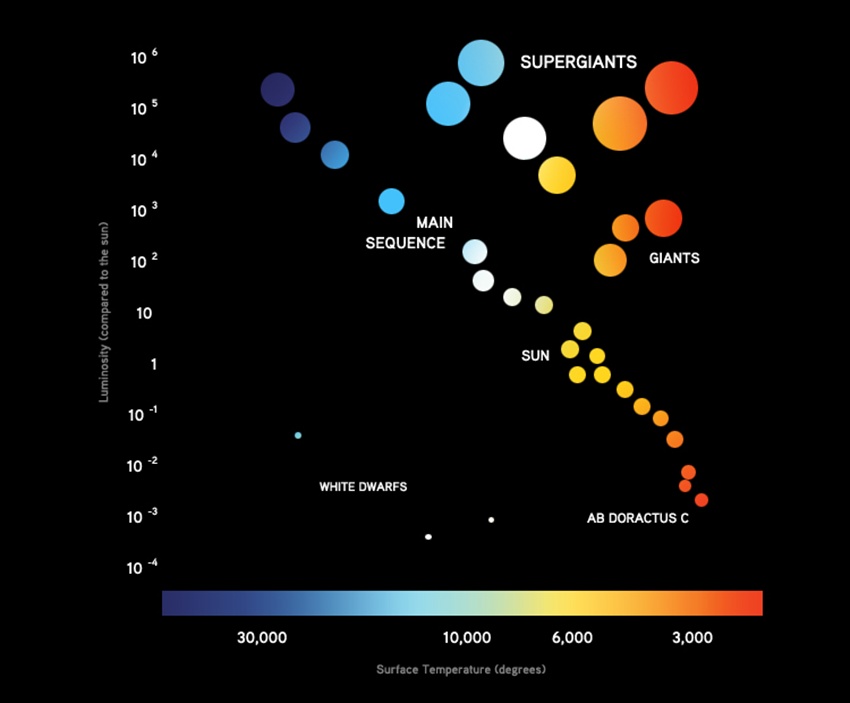
The lifetime of a star is directly related to the mass of the star. Very low mass stars burn their fuel slowly and have a much longer life than high mass stars. The standard classification of stars uses mass and temperature to distinguish between types of stars. Stars are classified as one of the following types: O, B, A, F, G, K, and M. O type stars are the most massive and hottest stars with temperatures around 40 000 K while M type stars have temperatures of 3000 K. Our sun is a type G star with a surface temperature of 6000 K.
Image credit: quora.com
The lower mass (lower temperature) stars burn their fuel more slowly while the higher mass (higher temperature) stars burn through their fuel more rapidly. It is believed that almost all of the low mass M type stars that were ever formed still exist and nearly all the high mass O and B type no longer exist.
The image above shows where stars fall based on the temperature and luminosity or brightness. Blue giants and supergiants occupy the top left of the diagram. Our sun occupies a spot near the middle of the diagram while red dwarfs are located near the bottom right of the chart. Stars spend 90 % of their lives on the main sequence portion of the diagram. While on the main sequence stars are actively fusing hydrogen in their cores. As a star begins to exhaust its fuel supply the star may move off of the main sequence portion of the H-R diagram. This occurs when hydrogen becomes depleted at the center of the star’s core.
The Death of an Ordinary Star
When a star such as our sun begins to fuse elements other than helium in its core the star will enter the red giant phase. The star will expand to more than 400 times its normal size. In the case of our sun, this would mean that it expanded to the orbit of Mars. Over time the core of the star shrinks and the core begins to fuse helium into carbon-12. A star with a 10 solar mass will enter the red supergiant phase rather than a red giant phase when it begins fusing carbon. The initial mass of the star determines if it eventually becomes a red giant or a red super giant. A red super giant will expand beyond the orbit of Jupiter. Helium flash occurs as the star fuses the helium to carbon as described above. This phase will last approximately 100 million years at which point the helium is exhausted. The helium flash is a runaway nuclear reaction caused by the sudden ignition of helium. “About 6% of the electron-degenerate helium core, which by now weighs in at about 40% of a solar mass, is fused into carbon within a few minutes. (This corresponds to burning roughly ten Earth masses of helium per second, if you are keeping score.) time.”(https://faculty.wcas.northwestern.edu/~infocom/The%20Website/end.html)
Image credit: science forums
A low mass star eventually “will lose all of the mass in its envelope and leave behind a hot core of carbon embedded in a nebula of expelled gas.” (https://map.gsfc.nasa.gov/universe/rel_stars.html) The planetary nebula left behind will eventually be used in the creation of other stars. What once was a sun like star is now nothing more than a carbon core called a “white dwarf” surrounded by a planetary nebula.
When a star goes supernova it becomes the brightest object in the sky and can be seen even in daylight. One result of a star of a massive star (8-18 solar masses) that has gone supernova is a neutron star. A neutron star is an incredibly dense remnants of a supernova explosion. They are 1.4-3.2 solar masses condensed down to the size of approximately 20 kilometers. According to EarthSky.org a tablespoon of a neutron star would weigh more than 1 billion tons! They are called neutron stars because all of the electrons and protons are compressed and combined to form neutrons. Some neutron stars spin very rapidly and emit radio waves from the poles. These are called pulsars and have extremely powerful magnetic fields. Here is a cool video about pulsars. https://youtu.be/VxVlwAvi6Zo
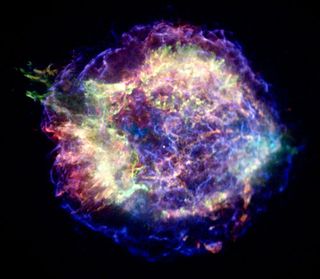
The remains of a supernova called Cassiopeia A, located in our galaxy about 11,000 light-years from Earth. Credit NASA
Black Holes
Stars with a very high mass, approximately 18 solar masses or greater, end their lives by becoming a black hole. Most people are aware that black holes are a region in space where the gravitational force is so strong that not even light can escape it. The reason the gravity is so strong is because the entire mass of the star is compressed down to an incredibly small size relative to the stars size prior to it going supernova.
Stellar black holes can be up to twenty solar masses or 20 times the mass of the sun. A new class of black holes were coined as intermediate black holes. These black holes are in between the stellar black holes and super massive black holes. In 2014 an intermediate black hole was found in the arm of a spiral galaxy according to space.com. Supermassive black holes may be 1 million times the mass of the sun or more. These are often found at the center of galaxies.
Sagittarius A is a supermassive blackhole at the center of the Milky Way galaxy and it has a mass of about 4 million solar masses. Black holes were predicted by Einstein in 1916 but not observed directly because it does not emit any light. All that changed on April 10th 2019 when the first image of a black hole was presented to the world. This black hole is from the center of galaxy M87 which is about 55 million light years from Earth.
Credit: sciencenewsforstudents.org
Here is one last video giving a quick description of how a dying star becomes a white dwarf, a neutron star, or a black hole. Spoiler, it is due to the mass of the star. https://youtu.be/NucdlR9EGbA
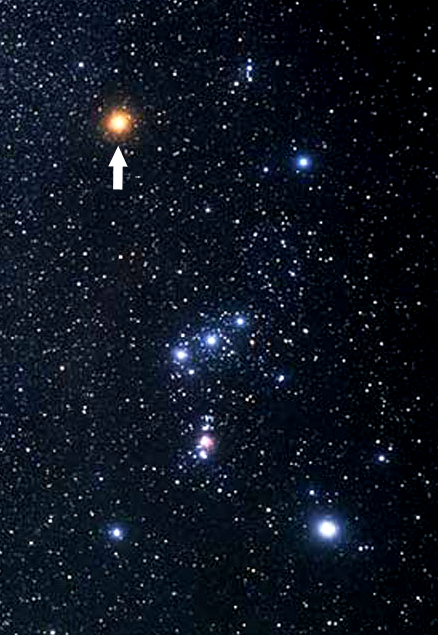
The red supergiant, Betelgeuse has been in the news recently because of its unexpected behavior. Astronomers have noted that since October 2019 the red supergiant had been dimming and the star is now less than 40% of its normal brightness. Before we discuss what this means for the star let me introduce you to Betelgeuse.
Betelgeuse is between 640-724 light years from Earth and is the alpha or brightest star in the constellation Orion. Betelgeuse and Bellatrix make up the shoulders of Orion, the Hunter. Betelgeuse used to hold the distinction of being one of the top 10 brightest stars in the sky but has fallen to below 20th since it began dimming in October 2019. Betelgeuse is believed to be between 9 and 10 billion years old with a solar mass that is 12 times more massive than our sun.
Image: Akira Fujii
Red Supergiants
So what is a red supergiant star? Red supergiants are stars of a specific size that are nearing the end of their lives. These stars spend only about 10% of their lives as red supergiants while the prior 90% is spent as a massive main sequence star. These stars have a mass greater than 10 solar masses meaning these stars have more than ten times the mass of our sun. In these stars most of the hydrogen fuel has been exhausted and the core stops producing energy and gravity causes the core to contract. The layer of the star surrounding the core contracts and heats up to a high enough temperature to start fusing hydrogen to helium. The outer parts of the star expand as a result of the star burning hydrogen. The star is producing more energy than necessary to offset the collapse due to gravity. The outer layer expands to several hundred solar radii and the surface temperature cools as a result of the increased surface area. This temperature decrease gives the star its reddish color.
Courtesy of se.ssl.berkeley.edu
The Dimming of Betelgeuse
Betelgeuse belongs to a class of stars called Cepheid variables or variables. These types of stars, according to universetoday.com “are essentially stars that experience fluctuations in their brightness (aka. absolute luminosity)”. So this means that some dimming from Betelgeuse is to be expected. Betelgeuse is considered to be a semi-regular variable star or slow irregular variable star which means its brightness or luminosity fluctuates in fairly predictable cycles. One cycle lasts for approximately 420 days, a second longer cycle lasts for close to six years, and a third cycle lasts somewhere between 100 and 180 days. The current reduction in brightness is larger than expected which has led to questions about what this means for the red supergiant. Some scientists think that this dimming is simply an extended dimming period lasting longer than the 420 day cycle while others speculate that Betelgeuse may be heading towards its ultimate demise, a supernova explosion. The European Southern Observatory (ESO) posted a video comparing the luminosity of Betelegeuse from December 2019 to January 2020, you can view the video here: https://www.youtube.com/watch?reload=9&v=o1ls7Gr9LTE According to ESO “this video shows the star Betelgeuse before and after its unprecedented dimming. The observations, taken with the SPHERE instrument on ESO’s Very Large Telescope in January and December 2019, show how much the star has faded and how its apparent shape has changed.”
What is a Supernova and When Might it Occur for Betelgeuse?
According to nasa.gov, a supernova is “the explosion of a star. It is the largest explosion that takes place in space.” There is some speculation that Betelgeuse is nearing the end of its life and may go supernova in the near future. Let’s be clear about the meaning of “near future”. In our everyday life the “near future” may be a few days, a few weeks, maybe even a few months. Is astronomical terms, the “near future” may mean anywhere from a few thousand years to over a hundred thousand years. It is all based on your reference. Astronomers are comparing a few thousand years to the age of the universe which is estimated to be nearly 14 billion years old.
When the iron core reaches its Chandrasekhar mass which is about 1.4 times the mass of our sun or 1.4 Solar masses, the pressure of the core can no longer hold up against gravity and the iron core begins to collapse. During this collapse the electrons and iron nuclei get mashed together and electrons combine with protons in the nuclei to form more neutrons. This combing of electrons and protons results in a decrease in pressure which speeds up the collapse. The collapse of the core takes a mere few thousandths of a second.
As the core of the star reaches a size of around 31 miles the core contains a gas consisting of 70% neutrons and 30% protons with a temperature of 100,000,000,000 K. This object is now a proto-neutron star. The outer layers are continuing to fall into the core and a stream of neutrinos are flowing out of the proto-neutron star. This flow of neutrinos results in an enormous release of energy causing the outer layers of the star to be blown away. This flow of neutrinos is responsible for 99% or this enormous energy and light is the remaining 1% of the energy.
The brightness or luminosity of a supernova is 10 billion times greater than that of our sun. A supernova may outshine its own galaxy for several days. So why aren’t we seeing supernovas all the time? Shouldn’t we be able to detect them by the enormous luminosity? Scientists have found that core collapse supernova only occur at a rate of 1 supernova per century per galaxy.
Types of Supernova
There are several different types of supernova. They are classified by the type of light that is emitted by star. This can be thought of as the chemical signature of the star. These signatures help astronomers determine what elements are present in or created by the star.
The first is called type 1a supernova. Scientists believe that this type of supernova occurs when white dwarf stars, those stars who had masses less than 1.5 times the mass of our sun, acquire more mass than its internal pressure can withstand so it heats up and goes supernova. A star that became a white dwarf would not normally be massive enough to go supernova. The white dwarf is thought to have gained the mass from colliding with another white dwarf of from a companion red giant.
The next type of supernova is the type 1b supernova. In this case the star had a mass at least 25 times the mass of our own sun. It certainly is massive enough to go supernova. This type of star is thought to have shed material from its outer envelope later in life which is why there is little hydrogen in its spectrum. This type of supernova does show helium in its spectrum.
Type 1c supernova contain very little hydrogen and helium and are formed the same way the type 1b supernova are formed. The difference between type 1b and 1c is the lack of helium found in the 1c supernova.
Type II supernova or core collapse supernova contain large amounts of hydrogen and helium in its spectrum. It is believed that large stars with masses are larger than 8 times the mass of our sun undergo this type of supernova. The massive explosion results in the creation of a blackhole or a neutron star. This is the type of supernova a red supergiant, such as Betelgeuse, will undergo at the end of its life.
Types of supernovas. Courtesy of astronomy.swin.edu.au
Why Do We Care about Supernovas?
It turns out stars only produce elements up to iron through the fusion reactions in their core. So that begs the question, where do elements heavier than iron come from? Well, the extremely large amounts of energy and the enormous temperatures associated with supernova explosions can cause fusion of the heavier elements. These heavier elements are shot out through the universe during the supernova explosion. Many of the elements we have found here on earth were created in the core of a star during a supernova. The elements that travel through the universe eventually are used to create planets, new stars and anything and everything else in the universe. According to nasa.gov/audience/forstudents “one kind of supernova has shown scientists that we live in an expanding universe, one that is growing at an ever increasing rate.” So that’s why you should care about supernovas!
Elements heavier than iron that are formed in a supernova explosion. Courtesy of herschel.jpl.nasa.gov
Neutron stars: One of the universe’s most exotic and bizarre objects.
Most people are familiar with black holes and understand that they are created when a massive star, one that is greater than 30 times the mass of the sun, dies. Stars that are similar in mass to our sun ranging from about .3 times the mass to 8 times the mass of the sun become red giants when they die. So what exactly is a neutron star? Neutron stars are the result of a collapsed star that is approximately 25-30 times the mass of our own sun. The star goes supernova at the end of the its life. When a star runs out of nuclear fuel and nuclear fusion within the core slows, the result is a decrease in pressure. This drop in pressure causes the star’s core to compress under the strain of it’s own gravitational forces. Without the offsetting pressure to maintain the stars structure the core collapses in a few thousandths of a second.
Courtesy of NASA
The core temperature of a star that has gone supernova may exceed billions of degrees Celsius or 100 000 000 000 K. The star undergoes a fantastic explosion that is called a supernova. The luminosity of a supernova may be up to 10 billion times greater that of our own sun. The supernova may even outshine its entire galaxy for a few days. The rate at which core collapse supernova occur is approximately 1 supernova per century per galaxy.
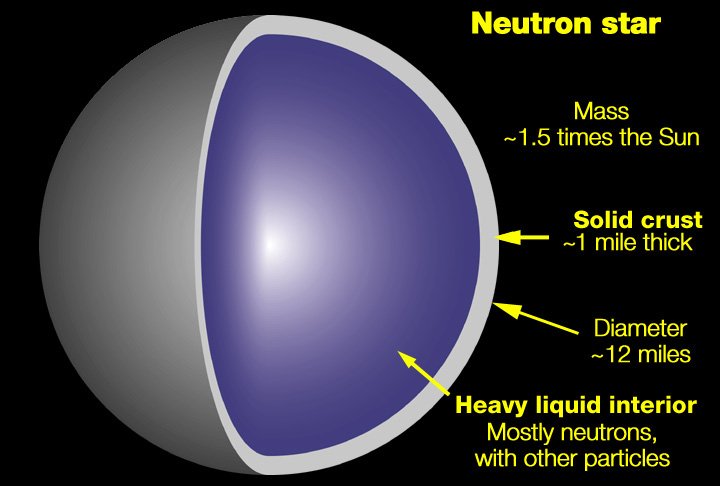
Once a star within the 25-30 times the mass of our sun has gone supernova, what happens to its left over core? One possibility is that the core stabilizes and becomes a neutron star. A neutron star is thought to be composed of a super-fluid an exotic friction free state of matter of neutrons. The electrons and protons inside the star have been compressed to create the neutrons found in the super-fluid state. A neutron star may be only 12 miles in diameter and have a mass of 1.3-2.5 the mass of the sun. So how did a star that was 25-30 the mass of our sun end up being a core that is only 1.3-2.5 times the mass of our sun? When the core of the star is collapsing the outer layers of the star get removed due to the large amount of energy that is released by the star. A large majority of the energy released by the star is in the form of neutrinos (99% of the energy) while the remaining energy released is in the form of light. The matter within a neutron star is so densely packed into the 12 mile diameter that a sample of the neutron star the size of a cube of sugar would weigh 1 billion tons.
Why should we care about neutron stars?
Scientists have long wondered where elements heavier than iron were created. Dying stars produce elements up to iron but little was known how the heavier elements were produced. As it turns out during a supernova, heavier elements including gold and platinum may be produced. In order for these heavier elements to be produced a neutron rich environment is needed. A process called ‘r-process’ or rapid neutron capture process is used to create these heavier elements. Neutron stars, as you might guess from the name, provide just such a neutron rich environment. One theory suggests that the merger of neutron stars is a mechanism for r-process and the creation of these heavy elements.
Interesting facts about neutron stars
The gravity of a neutron star is approximately 200 billion times greater than gravity on Earth.
The magnetic field of a neutron star is approximately 1 trillion times greater than on Earth.
The electric fields of a neutron star are 30 million times more powerful than a bolt of lightning.
Neutron stars rotate several hundred times per second with the fastest known neutron star, PSR J17482446ad, rotating over 700 times per second.
There are about 100 million neutron stars in the Milky Way galaxy.







 Neville’s Phantastic Physics Phun