
If you have ever found yourself awe struck by the beauty and mystery of stars in the night sky you are not alone. The night sky and stars in particular have fascinated and inspired people since the dawn of man. Stars have been used to help sailors navigate the ocean, been used to predict the harvest, and even for religious purposes. Science fiction and pop culture are full of ideas about traveling to the stars or “shooting for the stars” and you can even find registries online that will let you name a star. So a logical set of questions you may have asked yourself are how are stars created, how long do they live, and how do they die?
Fun Facts about Stars
Before we dive into answering those question let’s discuss some facts about stars. Some of these you may know and others may be news to you. There is only one star, our sun, in the our solar system but there are over 100 billion stars in the Milky Way galaxy. The Alpha Centauri system contains the three closest stars, other than the sun to Earth. The stars in this system are Alpha Centauri A, Alpha Centauri B, and Proxima Centauri. Alpha Centauri A & B are a binary pair of stars with an average distance of 4.3 light years from Earth while Proxima Centauri is roughly 4.22 light years from Earth.
Let’s describe some of the terms discussed above. A binary pair can be defind as “… two stars orbiting a common center of mass. The brighter star is officially classified as the primary star, while the dimmer of the two is the secondary (classified as A and B respectively).” (https://www.space.com/22509-binary-stars.html) Despite the term year appearing in the word, a light year is not a measure of time but rather a measure of distance. A light year is the distance that light can travel in one year. Light travels at an incredibly high rate of speed, how fast you ask? Try 300,000 kilometers per second or 186,000 miles per second. So a light year is approximately 9 trillion kilometers or 6 trillion miles. So if we could travel a 186,000 miles per second it would take us 4.3 years to reach Alpha Centauri A & B.

How are Stars Formed
With over 100 billion stars in our Milky Way galaxy alone an obvious question is where did these stars come from and how are they formed? Well I’m glad you asked. Stars are formed in stellar nurseries called nebula. According to https://spacecenter.org/what-is-a-nebula/ a nebula is “an enormous cloud of dust and gas occupying the space between stars and acting as a nursery for new stars.” These regions can be formed from the death of other stars via a supernova or from interstellar dust and gas found in the universe. The nebula can be some of the most breath taking features in the night sky.

The life cycle of a star is determined by the mass of the star itself. Stars with a greater mass end up having a shorter lifetime than other stars. So what determines the mass of a star? As it turns out, the mass of a given star is a result of the amount of matter available to it in the stellar nursery or nebula where it is being formed. Nebula provide gas and dust which slowly begins to collapse under its own gravity. As the amount of matter begins to increase the temperature and pressure also increase and the cloud begins to spin about the center of mass. This is the birth of a protostar. (also known as a T Tauri star) According to science.nasa.gov a protostar is the “hot core at the heart of the collapsing cloud that will one day become a star.” As the protostar continues to heat up it reaches a temperature of 15,000,000 K at which time nuclear fusion begins converting hydrogen to helium. When these atoms of gas are fused together the result is the release of an extremely large quantity of energy. This release of energy is a consequence of Einstein’s famous theory E=mc^2 which states that the amount of energy obtained from an object is equal to the mass of the object multiplied by the speed of light squared, an incredibly high number. Here is a short video clip from the Science Channel’s How the Universe Works “A Star is Born” episode. It can take close to 50 million years for an average star, such as our sun to form!
In order for the nuclear fusion to occur a star candidate must have a minimum mass of .08 the mass of the sun. Objects that have a mass that is between 15 and 75 times the mass of Jupiter are known as Brown dwarfs. Often called failed stars, Brown dwarfs are too large to be a planet and too small to be a star. It is believed that brown dwarfs form in the same way as stars do but these objects don’t have enough mass to allow for nuclear fusion to occur.

The Life and Death of a Star
The lifetime of a star is directly related to the mass of the star. Very low mass stars burn their fuel slowly and have a much longer life than high mass stars. The standard classification of stars uses mass and temperature to distinguish between types of stars. Stars are classified as one of the following types: O, B, A, F, G, K, and M. O type stars are the most massive and hottest stars with temperatures around 40 000 K while M type stars have temperatures of 3000 K. Our sun is a type G star with a surface temperature of 6000 K.
The lower mass (lower temperature) stars burn their fuel more slowly while the higher mass (higher temperature) stars burn through their fuel more rapidly. It is believed that almost all of the low mass M type stars that were ever formed still exist and nearly all the high mass O and B type no longer exist.
Hertzsprung-Russell Diagram
The Herzsprung-Russel of H-R diagram is “… a scatter graph of stars, a plot of stellar absolute magnitude or luminosity versus temperature or stellar classification. It is an important astronomical tool for understanding how stars evolve over time.” (https://science.nasa.gov/plotting-pulsating-variable-stars-hertzsprung-russell-h-r-diagram)
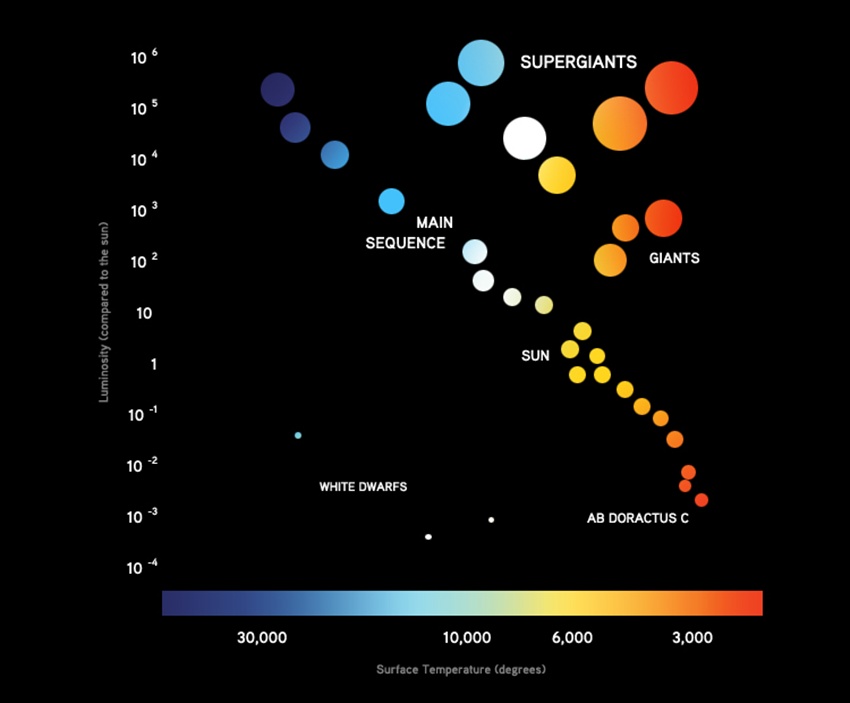
The image above shows where stars fall based on the temperature and luminosity or brightness. Blue giants and supergiants occupy the top left of the diagram. Our sun occupies a spot near the middle of the diagram while red dwarfs are located near the bottom right of the chart. Stars spend 90 % of their lives on the main sequence portion of the diagram. While on the main sequence stars are actively fusing hydrogen in their cores. As a star begins to exhaust its fuel supply the star may move off of the main sequence portion of the H-R diagram. This occurs when hydrogen becomes depleted at the center of the star’s core.
The Death of an Ordinary Star
When a star such as our sun begins to fuse elements other than helium in its core the star will enter the red giant phase. The star will expand to more than 400 times its normal size. In the case of our sun, this would mean that it expanded to the orbit of Mars. Over time the core of the star shrinks and the core begins to fuse helium into carbon-12. A star with a 10 solar mass will enter the red supergiant phase rather than a red giant phase when it begins fusing carbon. The initial mass of the star determines if it eventually becomes a red giant or a red super giant. A red super giant will expand beyond the orbit of Jupiter. Helium flash occurs as the star fuses the helium to carbon as described above. This phase will last approximately 100 million years at which point the helium is exhausted. The helium flash is a runaway nuclear reaction caused by the sudden ignition of helium. “About 6% of the electron-degenerate helium core, which by now weighs in at about 40% of a solar mass, is fused into carbon within a few minutes. (This corresponds to burning roughly ten Earth masses of helium per second, if you are keeping score.) time.”(https://faculty.wcas.northwestern.edu/~infocom/The%20Website/end.html)

A low mass star eventually “will lose all of the mass in its envelope and leave behind a hot core of carbon embedded in a nebula of expelled gas.” (https://map.gsfc.nasa.gov/universe/rel_stars.html) The planetary nebula left behind will eventually be used in the creation of other stars. What once was a sun like star is now nothing more than a carbon core called a “white dwarf” surrounded by a planetary nebula.
The Death of High Mass Stars

https://www.nasa.gov/audience/forstudents/5-8/features/nasa-knows/what-is-a-supernova.htmlLet’s talk briefly about the death of stars larger than our sun. If a star is roughly 8 times the mass of our sun (8 solar masses it likely will undergo a spectacular death. The death of this sized star is called a Type II supernova. A supernova is “…. the explosion of a star. It is the largest explosion that takes place in space.” (https://www.nasa.gov/audience/forstudents/5-8/features/nasa-knows/what-is-a-supernova.html)
When a star goes supernova it becomes the brightest object in the sky and can be seen even in daylight. One result of a star of a massive star (8-18 solar masses) that has gone supernova is a neutron star. A neutron star is an incredibly dense remnants of a supernova explosion. They are 1.4-3.2 solar masses condensed down to the size of approximately 20 kilometers. According to EarthSky.org a tablespoon of a neutron star would weigh more than 1 billion tons! They are called neutron stars because all of the electrons and protons are compressed and combined to form neutrons. Some neutron stars spin very rapidly and emit radio waves from the poles. These are called pulsars and have extremely powerful magnetic fields. Here is a cool video about pulsars. https://youtu.be/VxVlwAvi6Zo

Black Holes
Stars with a very high mass, approximately 18 solar masses or greater, end their lives by becoming a black hole. Most people are aware that black holes are a region in space where the gravitational force is so strong that not even light can escape it. The reason the gravity is so strong is because the entire mass of the star is compressed down to an incredibly small size relative to the stars size prior to it going supernova.
Stellar black holes can be up to twenty solar masses or 20 times the mass of the sun. A new class of black holes were coined as intermediate black holes. These black holes are in between the stellar black holes and super massive black holes. In 2014 an intermediate black hole was found in the arm of a spiral galaxy according to space.com. Supermassive black holes may be 1 million times the mass of the sun or more. These are often found at the center of galaxies.
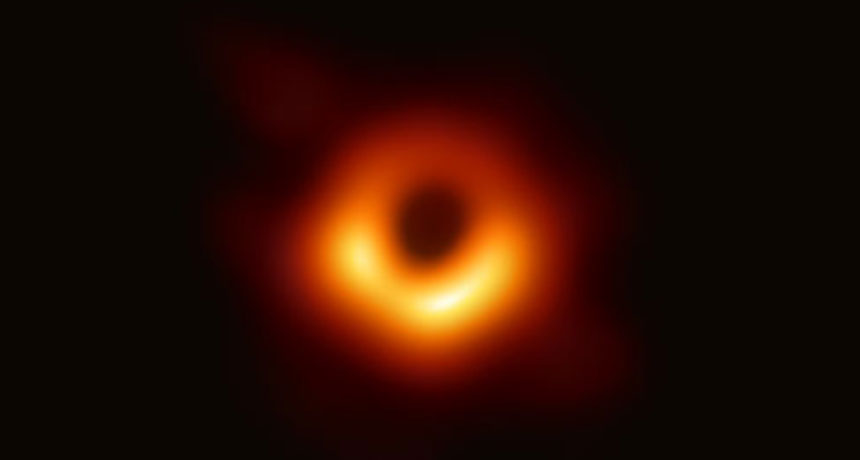
Sagittarius A is a supermassive blackhole at the center of the Milky Way galaxy and it has a mass of about 4 million solar masses. Black holes were predicted by Einstein in 1916 but not observed directly because it does not emit any light. All that changed on April 10th 2019 when the first image of a black hole was presented to the world. This black hole is from the center of galaxy M87 which is about 55 million light years from Earth.
Here is one last video giving a quick description of how a dying star becomes a white dwarf, a neutron star, or a black hole. Spoiler, it is due to the mass of the star. https://youtu.be/NucdlR9EGbA
 Neville’s Phantastic Physics Phun