You may have heard of the terms dark matter and if you read my post from last week then I know you have heard of dark energy. Let’s talk about dark matter, what it is and why it is called “dark”. We know a black hole is called black because it is not visible to us and even light can not escape its gravitational pull. So is dark matter called dark because we can’t physically see it? Well, yes actually. We are unable to detect it directly and are only able to infer its existence by the effects it has on other objects. So let’s take a closer look at what dark matter is and what it does.
What is Dark Matter?
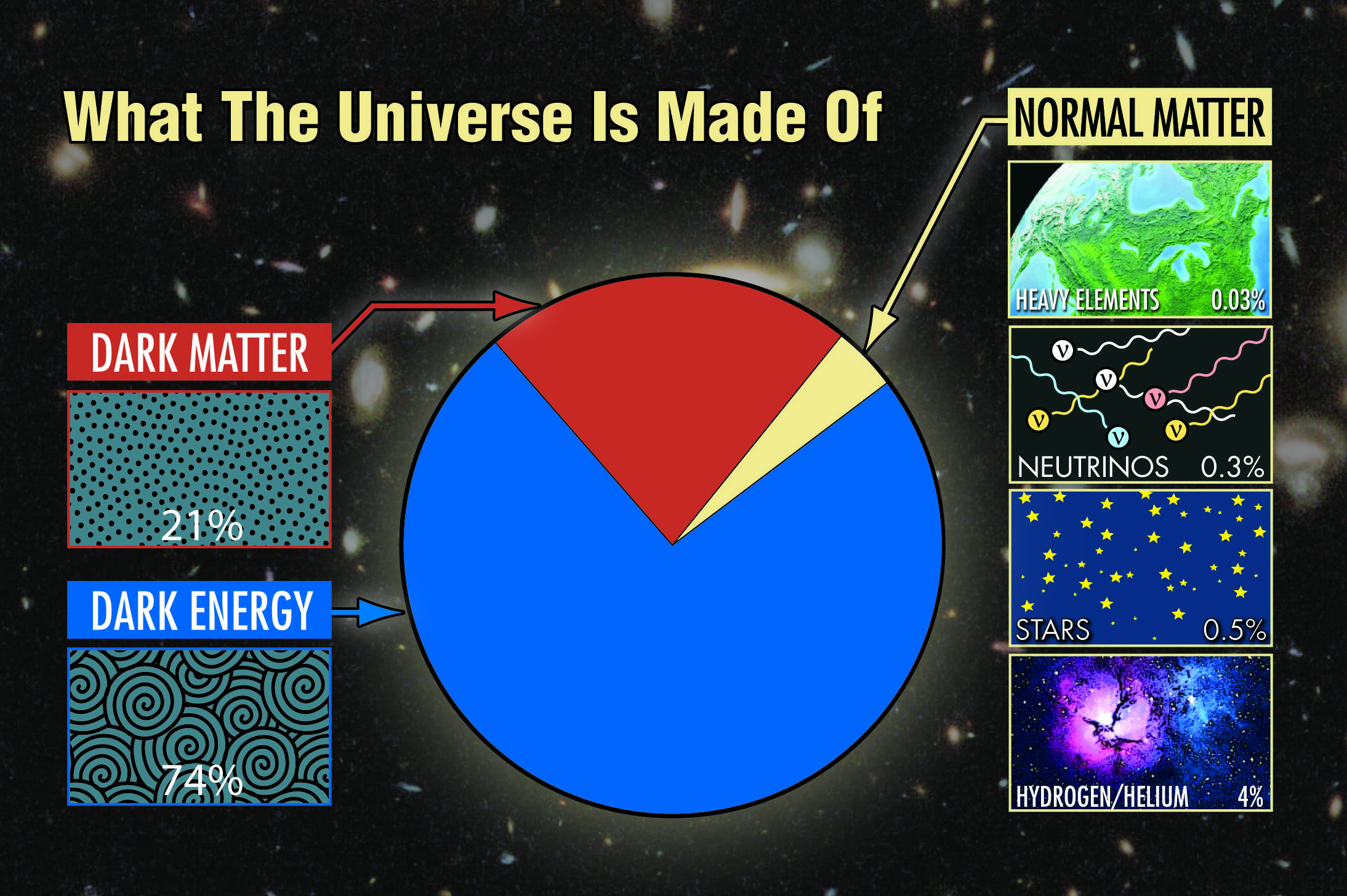
Dark matter comprises about 27% of the universe and dark energy makes up about 68% of the universe which means that only 5% of the universe is comprised of matter as we know it. This “normal” matter is called baryonic matter and is the matter we traditionally think of. Protons, electrons, atoms, anything that makes up everything from people to stars are made from baryonic matter. Dark matter, like dark energy is called dark because we are unable to detect it directly. Dark matter does not interact at all with the electromagnetic spectrum which means it does not reflect light, absorb light, or emit anything we can detect. As of yet no one has been able to directly observe dark matter. Dark matter is thought to be a previously undiscovered subatomic particle that does not respond to the strong or weak nuclear forces.
The key point here is that when scientists account for all the visible or detectable mass in the universe it doesn’t add up to be enough to account for the gravitational effects we observe. As stated above only about 5 % of the universe is normal or baryonic matter so that means the most of the gravitational interactions in the universe are a result not of baryonic matter but of something else. We call this something else dark matter.
There are several ideas as to what actually comprises dark matter. Speculation includes dim brown dwarf stars, white dwarfs, neutron stars and even black holes. Some scientists have dismissed theses objects as dark matter candidates because the gravitational effect needed to make up the “missing mass” doesn’t match the gravitational effect observed by these objects. Others have stated that the “missing mass” may simply be normal baryonic matter that is simply more difficult to detect.
WIMPs and MACHOs
Weakly interacting massive particles or WIMPS are theoretical particles of non baryonic matter which have somewhere between 10 and 100 times the mass of a proton yet interact very weakly with normal or bayronic matter so they are difficult to observe. If WIMPS are what make up dark matter then there should be 5 times as many WIMPS as normal matter. We should be able to detect them as they do interact with normal matter and the sheer abundance of them should allow us to detect them through collisions with each other. So far no WIMPS have been discovered.
Massive astrophysical compact halo object or MACHO is another candidate for the composition of dark matter. These are objects composed of bayonic matter but are difficult to detect because they emit very little to no light. These include the neutron stars, supermassive black holes, and brown and white dwarfs as mentioned earlier. Because they emit so little light one way to detect them is through gravitational lensing which we will discuss a bit later. It appears that there are not enough of these objects throughout the universe to make up the “missing mass”.

Other Dark Matter Candidates
Neutrinos are particles that aren’t associated with and don’t interact with baryonic matter. Neutrinos stream from the sun and pass through all regular matter, including us all the time. They are difficult to detect as they do not interact with matter. A new type of neutrino is thought to make up dark matter by some in the scientific community. Sterile neutrinos are a theoretical type of neutrino that have been proposed, they only interact with baryonic matter via gravity.
The Kaluza-Klein particle is a theoretical particle that would interact with the electromagnetic spectrum as well as gravity which should make them easy to detect. These particles are thought to exist in the fifth dimension making them difficult but not impossible to detect. The Kaluza-Klein particle is predicted to decay into particles we can readily observe, such as neutrinos and photons. As of yet though, none of these exotic particles have been observed.
How Do We Know Dark Matter Exists if We Can’t See It?
There are three pieces of evidence used to prove the existence of dark matter even though we can not detect it directly. The first is the speed of stars rotating on the outside edge of spinning galaxies. The stars on the outer edge should move at a much slower rate than those close to the center where most of the baryonic mass of the galaxy is contained. Direct observation has shown that these stars, at the outer edge of the galaxy, are moving at a rate very close to the rate of stars closer to the center. This has led scientists to the conclusion that there must be some mass distributed throughout the galaxy exerting a gravitational effect on the stars farther out from the center.
Stars, as it turns out, orbit their parent galaxy. By using Newton’s equations of force and the Universal Law of Gravitation we know that the force that causes the star to orbit in a circular orbit are equal to the force due to gravity on the star. If these forces were not equal then the star would careen into the center of the galaxy or fly off into space. Close to the center of a galaxy these forces are approximately equal as expected. Stars farther out from the center don’t appear to have these forces equal. So there has to be something going on to keep these stars in orbit. Dark matter is one such explanation.

Gravitational lensing is a well documented phenomena in which massive objects distort the fabric of space time. Light must travel along this fabric and if there are massive objects distorting this fabric then the the source of light may appear shifted from the actual position as a result of distortions in space.

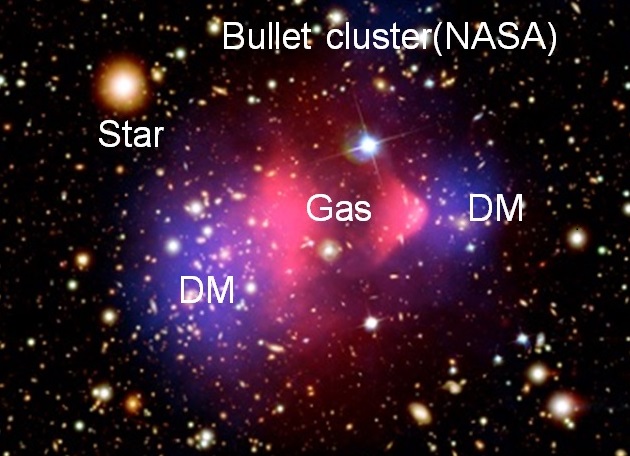
The third piece of evidence supporting dark matter is the the Bullet Cluster Galaxy merger. Two galaxies collided and due to only about 2% of a galaxy being made up of stars and roughly 5-15% being made up of gas and plasma there is a low probability of any baryonic matter colliding with one another. After the merger of the two galaxies gravitational lensing of background objects allowed scientists to determine where the accumulations of mass were located. It turns out that the dark matter was separated from baryonic matter in large enough quantities to cause gravitational lensing.
What if the Missing Mass is the Result of Something Else?
Not everyone is ready to accept that dark matter is responsible for the “missing mass” problem in the universe. Some scientists believe the problem isn’t that mass is missing but rather our theories and equations are incorrect. One particular idea is that Newton’s laws require a modification so that they match the observed behavior of galaxies. Those that support this idea have developed MOND or Modified Newtonian Dynamics as an alternative to dark matter. This theory suggest in situations when the acceleration rates are low Newton’s laws do not accurately describe the motion of galaxies. This alternative to dark matter is as still being developed and refined to better match observation.

Scientists know that the amount of baryonic matter which they are able to detect is not enough to hold galaxies together or keep stars from flying off into space rather than orbiting their parent galaxy. What is unknown is the precise mechanism causing the behavior observed by galaxies and stars. Dark matter is certainly the most widely accepted theory about our “missing mass” problem but it is by no means the only theory.
 Neville’s Phantastic Physics Phun